Skip to content
    • Books By Lonnie (Mike) Fulbright at Amazon.com
    • Email

THE DEFENDER

  • Desert Shield/Storm Ep #4

    August 20th, 2026

    As of today I am still assigned as security NCO for BDOC, but that was about to change, I am happy to say. At the “O” group this morning I was informed that we were organizing the first elements of the Anti-Terrorist section and that I would be taking over the duties as NCO. Lt. Mary, who would later go to Alpha sector, was going to be in charge of the day shift portion while Lt. Garneau to the night portion. The Col. did have another plan and that would take place as soon as he could get the man-power.  These are the first critical post as defined by OSI.

     LOCATION:                                                                 CALL SIGN:

    –Pilots quarters,                                                        Golf 7, 7a,

    –Army Chow Hall                                                      Golf 4, 4a,

    –Senior Officers quarters                                        Golf 6, 6a,

    –Hospital,                                                                   Golf 9, 9a

    –Two man Security patrol,                                     Golf 8. (Supervisor)

    NOTE: ALL THESE CALL SIGNS WILL CHANGE AT OFFICIAL IMPLENTATION OF DESERT SHIELD.

    Other than me, the others were temporarily assigned until the 17th. They were;

    11am-11pm

    Lt Mary                         A1C’s Holder, Miller, Moore, & Whelchel

    TSgt Fulbright              Amn Martin

    SSgt Mac

    Sgt Henderson

    SrA Biser

    SrA Ellwood

    11pm-11am

    Lt. “G”

    SSgt’s Bonner & Thibodea

    Sgt’s Scarbrough & Green

    SrA’s Kotrch, Melo, Rouscher, & Bennett

    A1C Liebig.

    Augmentee’s:

    Days; SSgt Hodge, Sgt Johnson, Sgt Elvidge, Sgt Klauss, Amn Morgan

    Nights: SSgt Toro, SrA Green, SrA Lindo, A1C Brown.

    Aug 15, 1990;

    The Anti-Terrorist (AT) section picked up 3 augmentee’s and lost 3.  They were just being rotated. 

    This is generally how my day would go before all the changes. 

    —I am posted as, before the new changes take effect, Golf Eight. 

    —I make sure all personnel are posted, and start the pick-up of off going.

    —I then start a battery replacement run and check communications. 

    —At about 14:00 I pick up MRE’s and begin delivery and post check. 

    —At 1700 there is an “O” group meeting at BDOC and I attend for updated information and to brief the commander on the day’s activities. 

    —After we dismiss I make another post check and report security status. 

    —At the end of shift I meet with oncoming and brief them on the day’s activity. 

    —I go get a shower and climb into bed for a much needed rest and up again in eight hours to prepare for the next duty shift.

    Aug 16, 1990:

    Operations are now speeding up and getting to be very hectic and saying that, I didn’t get much sleep from the night before and I was up at 06:15 and picked up at 06:30, man was it hot, I believe the temp was somewhere around 110, and because I am the NCO of the “Pack”, I was always posted on Golf 8. We gathered around outside BDOC where I briefed the men on their post and what intel we had.

    “Alright gentlemen, suspect everything and trust nothing. If it even looks suspicious, call it in. Monitor your radios and keep a watchful eye.”

    I got called in and informed about an additional two man patrol, call sign, Golf 2.

    Today I worked until 23:00, that’s about 17 hours and man was I tired.  But I guess that’s what we have to expect when you are trying to get everything established before anything significant happens. 

    Aug 17, 1990:

    Because of the ever increasing threat our posting requirements were about expand. Personnel security was of paramount importance, so, with the constant need and influx of personnel to fulfil those requirements, there was a need for an officer in charge. Lieutenant Garneau was selected for the job and officially given command of the AT section.  Another NCO who out ranked me (he was an MSgt) replaced me as well which meant that I take up position as Fire team/Security Response Team leader.  I am okay with the change because this thing is growing fast. So, I took my place as fire team leader and began making my rounds checking on the post. At about 1330 I was at the hospital compound checking on the men and we heard the temp had reached a scorching 137 degrees in the shade. I can’t remember who was posted there but he dropped out because of the heat – he was very dehydrated. 

    As the days moved on we continued to increase in personnel.

    DESERT SHIELD:

    ***Aug 18, 1990:

    Today the official “Desert Shield” began.  President Bush, and the UN Security Council, implemented this first phase of the operation in preparation for what they know is inevitable. The massive buildup of troops and equipment continued to pour in, as the huge transport planes, C-5’s, C-141s’, and contracted commercial planes were landing now around the clock.  It was the most awesome sight. Also today, for reasons that can’t be explained, we sent 28 personnel out about 30 miles north to an undisclosed location, and as we try to keep up with our daily task of beefing up our defense we wondered about that.

    THE ANTI-TERRORIST SECTION:

                  Capt. Stavaski (Our New Leader)

    Lt Garneau (No Picture and will Depart)

    Capt. Stavaski- New Leader

    TSgt Moyer, (TSgt Solie will relieve him)

    TSgt Craig

    TSgt Fulbright (Me)

    SSgt Dennis

    SSgt Archer

    SSgt Simmons (shorty)

    Sgt Smalls

    Sgt Fellin (rumor control)

    Sgt Stark

    Sgt Hamlin

    Sgt Baker

    SrA Bennett (Good at learning the lingo)

    SrA Snelgrow

    SrA Martin

    SrA Rogers

    SrA Iwaskiewicz (Hammer)

    A1C Jay Wagner (GI Joe)

    A1C Espinoza (Espo, a very funny guy)

    A1C Whelchel (Mr. Crazy)

    What a crew.  And as bases deployed their Security Police to our location Col. Pack used them to strengthen our perimeter. We didn’t see it at the time, but that was the reasons for the additional post. The situation dictated his actions. As Desert Shield progressed we would eventually have 484 Security personnel assigned, with about ½ in the A/T section.

    Aug 21/22, 1990: Monday/Tuesday

    I was Golf-8 getting off my 12/14 hour shift and had to brief the on-coming personnel. I arrived at our barrack where we had taken up residency and the on-coming shift was waiting in the front.

    TSgt Raymond Craig, better known as “Cowboy”, who had been reassigned from the flight line to the AT team, was the night shift team leader.  This was my first meeting of him.  It didn’t take me long to find out that this guy was a “BY THE BOOK GUY,” and I later found out he was a “T.I.” training instructor at none other than Lackland Air Force Base. It didn’t take very long for us to become very good friends.  He and I didn’t know it but at the same time we became friends, my wife and his wife were becoming friends as well back at Langley.  I briefed his team on the day’s activities and was relieved.

                  In the picture above you might notice the “GREEN CAMO” of the Hummer and how it, really blends in with the desert surroundings.  This is Ray on desert patrol. I can’t remember the call sign but I do know they will change because of Security Police, buildup. This was a two man team who patrolled a stretch of perimeter that we affectionately called “13 Miles to nowhere.”  If you got stuck out there at the end of the road it would literally be “The End of The Road.”   This road stopped at a fence line where you could see Khobar Towers.  As you see in the picture the Hummer has all four doors off but that will change.  Our Commander is going to decide later that we should put them back on because it was easy for someone to throw a grenade in.  Go figure.  If the doors are on then we would play the devil trying to egress and get blow’d up, out, and everywhere else you could imagine.

    Aug 21-28 1990:

    As you can see, with the ever growing number of personnel, not only security personnel, but support personnel as well comes an increase in posting.  So, on the 25th our command section, along with intelligence personnel (OSI), came up with our initial “Posting Priority Chart” for Charlie Sector. (And will be implemented on the 29th.

    Wed/Thur. Aug 29/30, 1990:

    Today is my Birthday. How about that?  Turning 34 was just like, well I was going to say, another day, but here, that is not the case. It’s not just another day. Oh well.

    With the implementation of the new posting we get new call signs and new hours.  “Charlie Mike” is the call signs for patrols, Charlie for “Charlie” Sector and “Mike” for mobile, entry control points had call signs of Charlie Echo, and for other stationary post Charlie followed by a number “C-6”. When it all got ironed out I really liked the 2300 to 1100, because I believed that if it was going to happen, it was going to happen then.

    Call Sign:      Description:

    C-1                 Pilots Quarters Front Perimeter

    C-1a                 “             “          Rear Exterior Foot Patrol

    C-2                 Dorm Compound ECP Guard

    C-2a                  “           “               Front Exterior

    C-2b                  “           “               Foot Patrol

    C-3                 Senior Officers QTRS Front

    C-3a                  “           “             “      Rear

    C-E-1             Gate One

    C-E-2             Gate Two

    C-6                 Dover Cops Billets Front

    C-6a                    “         “        “       Exterior Patrol Rear

    C-7                 Hospital Dorm ECP Front

    C-7a                     “            “      Compound Foot Patrol Leader

    C-8                 Mission Inn C/I Patrol Eastside

    C-8a                    “          “    Extended Patrol

    C-M-1            A/T SRT Leader

    C-M-1a                         Member

    C-M-2            A/T Fire Team Leader

    C-M-2a                                     Member

    C-M-2b                                     Member

    C-M-2c                                     Member

    Charlie Base   Sector Control (Two Controllers)

    C-M-5            Flight Sergeant

    C-M-6            Flight Commander

    Here is our daily routine.  At 22:15 we load up on the duce and head to tent city for guard-mount. We already have our weapons and equipment with us so that’s not a problem.  At guard-mount we receive our daily intelligence reports, radio freq’s, sign/countersign and post assignments. 

                  During tonight’s shift I am posted with SSgt Fopma, SrA Snelgrow, and A1C Wagner as a fire team, call sign, Charlie Mike Two (CM-2).  The off going came in and we took over the vehicle which was a Humvee. The 60 gunner, Wagner, checked the weapon, (pre-mounted and stayed with the vehicle) and ammo. I checked the rest of vehicle and accounted for all vehicle equipment. Everyone placed his gear where it could be reached in a hurry.

    Earlier, because we thought it would be more tactically advantageous, we removed the doors on the Hummers. We reasoned that if a grenade or any other type of explosive were thrown in, we could easily dismount and be able to run, thus lessening the possibility of getting our butts blown off. Our Commander got word of it and told us to put them back on. His reasoning was the reverse of ours. He said that a grenade could easily be thrown into the hummer if the doors were off and he wanted to prevent that. His reasoning is valid, but so was ours. But I guess you know who won. So, with the doors re-installed, we departed tent city and began the patrol of our assigned areas. 

    There was the normal talk of what we thought was going to happen, how long we thought we’d stay in country, and so on. Here is where SSgt Fellin comes in. He is our Rumor Control officer. If anyone knows anything it’s him. Oh yes, he could tell you the date and time of Victory. We all wanted to believe we were going home so we always got our hopes up. What we really didn’t think about was that this was a real war and that meant we stayed until it was over or you were dead. All of us were scared and really didn’t want to be here. Some knew how to handle it and keep their fears inside, others, as we learned, would do anything to get out of here. One man of whom I will not name, claimed to be a contentious objector. He was given an Art-15 and sent home to be put out of the Air Force. I guess he REALLY didn’t like the idea of being killed here. None of did. I guess he just couldn’t handle it, especially when he found out that we might be chemed.

     Back to the hummers; I don’t remember how long it was but, after a while we were told we could remove the doors of our Hummers again for ease of access and egress.  

    Nothing out of the ordinary was happening and it seemed that it was going to be a quiet night until around 03:55. 

    “Charlie Mike Two this is BDOC, over.”

    “Go ahead BDOC.” I say into the mic.

    “Charlie Mike Two we have a report of suspicious activity around the hospital compound, need you in route to check it out.”

    “Copy that, we are in route.”

    At the hospital compound Charlie 7, Sgt Stark, and 7a went on full alert taking up a defensive position.  Upon our arrival we secured the area and began a sweep.  Posted on top of the building was SrA Smalls (C-7a).  I contacted him and had him provide our over watch.   Sgt Stark (M16) and SSgt Fopma, on the 60, secured the entrance as Wagner, Snelgrow and I made the sweep.  A1C Wagner took the point and led us around the south end of the building.  As we came in contact with hospital personnel we directed them back into the building and told them to secure each entrance door until we cleared the area. No contact was made with any anyone on the outside, so we declared the area safe.  After our report to BDOC we continued our patrol and at 11:55am our shift came to an end.

    Sat/Sun 1/2 Sept, 1990:

                  I am posted as CM-2, (Fire Team). Tonight was just another night. We patrolled around the base and checked on the Charlie Echo’s. All was quiet until 02:55.

    “Charlie Base to all patrols we have just had a possible intrusion attempt at our location.”

    “Charlie Mike Two responding.” I said and hammered down. When I got into the area compound of Charlie Base and met up with the other members of the back-up forces, 15 personnel in all.  We spread out and conducted a sweep of the entire area with negative results.  The search and clear operation took about an hour and a half.  It was quite exciting to say the least.  The rest of the shift was rather uneventful.

    Thur. 13 Sept 1990:

                  Today is our anniversary.  Let’s see, that is 16 years.  Oh yeah, that’s right, I remembered.  Happy Anniversary to my darlin.

    Sun/Mon. 16/17 Sept, 1990:

                  Here is one of those intelligent decisions that we always seemed to be caught up in. We lost the Hummers. That’s right, lost them. Why, you may ask. Well, it seems that someone had an accident in one of them, so the solution is, take them away, stupid, right.  Here we are in a hostile area, so you have to expect a little something is going to happen. Well that’s our commander.   

    Wed/Thur. 19/20 Sept, 1990:

                  My posting consist of CM-1, and CM-2.  CM-1 is the Security Response team, (SRT), and CM-2 is the Fire Team.  Today our command structure, is trying to figure out a six and one schedule.  We also split the fire team into two patrols. I can’t remember what the call signs were. I would assume CM-3, 4 respectively.

    Sun/Mon. 23/24 Sept, 1990:

                  We started “officially” patrolling the perimeter today.  Remember “13 miles to nowhere,” well this is it.  If you go straight across from the gate that leads into the Flight line you enter the perimeter road and if you turn left you go to the tent city entrance.  Tent city was located directly behind and to the left of the hanger where we in processed.

    We also, as per order of Wambo, started sending out a four man interior recon team at night.  This was his special hit team, as we called it, and I guess it might be a good idea but why only at night.  Why not during the day light hours?  But, he is the one making all the decisions.  And the decisions he is making, are some we don’t understand. But we noticed that he doesn’t listen to his the advice of his NCO’s. There are tactical decisions that really seem to be completely of no sense.   

    Here is an example of a bad tactical decision. The Colonel wanted to put M-60’s to cover the ECP’s and one position was down from CE-2. But, when he supposedly surveyed the area he decided that the position should be set up on the outbound side of the road. There were two lanes there, a divider, and two lanes on the other side (In Bound). Now logic would dictate that if you are covering the inbound lane you would put the position on that side of the road. When we brought it up to our leadership, they brought it up to the commander. He said the positions stay in place.   

    This Picture shows C-141s as they come in and off Load the Air Borne.

                  As we secured the flight line and other areas we were able to witness the huge amount of air craft coming in and off-loading men and equipment. There were hundreds and thousands of personnel and as soon as they processed in they set up their own tent cities with outside type toilet and shower areas.

    This Is Cowboys Office.  My office looked just as organized.

    Something about TSgt Raymond Craig, he always seems to know just where to find the play toys.  Not sure what night this was but the guy next to him is no US, he is Brit.

    On Night Patrol looking for “I-Wackie’s”

    “Just sit right back and you’ll hear a tale, a tale of a fate full trip.” Talk about Gilligan’s Island.  Notice that “Swagger” and the hat in the shape of a Gentleman gambler.  Also, the way he holds his weapon is the way all of the old timers held them which became our trade mark.  You could always tell who we were by the way we held our weapon.

    Tue/Wed 25/26 Sept 1990:

                   Today I am on CM-1 with SSgt Archer.  We checked out the vehicle, did our normal routine and post checks.  We were on the 2300-1100 shift and were told in guard-mount that we would begin allowing the Saudi guards to ride with the patrols. We didn’t like the idea but complied and at 23:50 we picked up our “Ride along.” Somewhere around 02:00 we decided to patrol around the “13 Miles” to nowhere strip.  We crossed the main road and started the long trek.  It was night and we were running with blackout lights.  I was driving rather slowly and not really looking for anything in general when I looked off to my left and noticed a Hummer that looked to be hiding in some brush about 70 meters off the road.  I knew who it was and thought maybe he was trying not to be seen as if he were playing a little cat and mouse, so I kept driving, thinking that maybe I’d double back around and catch him from the rear.  As I drove past I got about a hundred meters away and heard SSgt Shorty Simmons yell, “Sergeant Fulbright.”  I stopped and looked back.  Then I drove down the slight embankment and headed back to where the hummer was.  I pulled up slowly facing the hummer.  When I got to where I could see it clearly I stopped.  I looked straight at it and then slowly looked over at SSgt Archer who had a big grin on his face.  We both got out and busted out laughing.  Ray, my good friend, had gotten his Hummer stuck.  It wasn’t stuck as you’d think about “in mud”, no sir, the Hummer was actually resting on sand and all four wheels were off the ground.  Ray just looked at us and then back to his Hummer.

                  “Yes, that’s right, it is stuck,” he said smiling.

                  “Yes but…”

                  “I know.  All four wheels are off the ground and just spinning.”

                  “Well, we can’t push it off so what do you suggest?” Archer said already heading for the winch on the front of our Hummer.

    After everyone stopped laughing we hooked up the winch and pulled them out.  Ray told me that he’d wanted to get one stuck and he finally got his chance.

    Wed/Thur. 26/27 Sept, 1990:

                   I am with Sgt Hamlin on CM-3.  Today we were given intel that a car is going to be used (a remote BMW), as a bomb to blow something up.  All of the entry points were watching for it. I was surprised to hear that the Col. Gave Capt. Ski and TSgt Solie a hard time for not giving the complete story.  The BMW never showed up.

    —11:00; it is about shift change time and a situation developed at CE-2 with A1C Espinosa (Espo).  We respond, and are informed, that a Philipino came up to CE-2, and asked about how he could get to where Sgt Deleon was so that he could fix his car.  After a long wait, we find out that Deleon did know that he was coming but the Phillipino had no pass.  He was detained for about twenty minutes and after that amount of time, Espo got on the horn with BDOC and of course no assistance there.  Deleon finally showed up and that was that.

    Thurs/Fri 27/28 Sept, 1990:

                  We started a 6-1 schedule and today is, my first day off.  Yes, that is correct, I said “day off”.  I had cloths to wash, letter to write, maybe do some reading or go watch a movie in the movie tent, just having a great time in a potential war zone.  Yea.

    Fri/Sat 28/29 Sept, 1990:

                  CM-2 with Hammer.  Just another night and day.

    Sat/Sun 29/30 Sept, 1990:

                  CM-1 with Sgt Stark. Today we hope that all we be quite on the perimeter.  We might, however, run across the four man recon team out near Khobar Towers.  

                  This morning we had two more 44 man teams come in.  Whiteman AFB and Vandenberg AFB.  Whiteman has been assigned to Charlie sector while Vandenberg to Alpha.  Now you would think that maybe there was a little relief in sight with these new teams arriving.  Wrong a-amundo.  Not a chance.  Our commander has already made the plan for additional posting and he implemented it as soon as the two teams hit the ground. And so the hits just keep on coming.

                  At 04:30 we came in and dropped off our Saudi counterpart, and went mobile until chow relief.  Then at 08:15 we picked up another Saudi and headed back out to the perimeter.

                  At about 09:45 Stark and I were parked out on the far end of the perimeter when the subject of religion came up.  We talked about an hour and I told him how to be saved.  He told me that his family always went to church and that they were very religious.   11:00 we headed back for tent city to prepare for our relief.

    Sun/Mon 30 Sept/01 Oct, 1990:  23:00-11:00

                  CM-2 with Stark again.  Our initial duty is chow pick up.  We go and get the MRE’s and I play a little game with everyone.  I called it “Win, Lose, or Draw.”  You get to choose one MRE, out of a new box, and have the choice to keep it or throw it into the MRE junk box.  If you throw it into the junk box you then get to choose from the old MRE box from the night before, but this time you have to keep what you get.  There is one MRE that no one likes, that is the Chicken-a-la-king, called “Chicken-a-la-THING” because no one really knew what it was. A lot of fun.

    The cops from Vandenberg AFB brought with them a Captain who thinks that he is the one with all the Knowledge.  His name is GI Hopper.

                  Found out today that it looks like we are expecting to be attacked around

    the first thru the fifth of October.  Defense just got intensified.  We started building bunkers on every gate and setting up additional 60 machine gun pits at Strategic points.  We also placed a four-man fire team behind the Pilot’s quarters.  Intel has it that Terrorist, have been seen in and around the base with some possible Shootings. 

    01/02 Oct, 1990, 23:00-11:00;

    CM-1…Craig

    CM-2…Perry

    CM-3…Fulbright

                  Today we had a fire at the chow hall.  It was a fuel tank that everyone thought maybe a terrorist act but decided later that it was not.  No other excitement today.
  • Podcast Episode: Desert Shield/Storm as experienced

    August 18th, 2026

    Pip: THE DEFENDER is back, and this time we're going somewhere most podcasts won't — the Gulf War, from the ground up, told by the person who was actually there.

    Mara: lonnie fulbright takes us through Desert Shield and Desert Storm as lived experience — not the briefing-room version, but the one that happened to a real person in real time. That's the territory today.

    Pip: Let's start with what it actually felt like to be there.

    Desert Shield and Storm: A Firsthand Account

    Mara: The question this post puts on the table is a simple but serious one — what did Desert Shield and Desert Storm actually look like from inside them, not from a historian's remove, but as someone living through the uncertainty day by day?

    Pip: The post points readers directly to the account itself, and the framing does the work: "Desert Shield/Storm by Lonnie M. Fulbright (Mike)" — that parenthetical "Mike" is a detail that signals this is personal, a nickname, a human being, not a unit designation.

    Mara: What that means in practice is that the record being preserved here isn't institutional. It's the kind of account that disappears if no one writes it down — the texture of waiting, the specific geography of anxiety that a deployment carries before a shot is fired.

    Pip: There's something worth sitting with in the structure of the title itself — Desert Shield comes first. The war that almost wasn't, the months of positioning and not knowing, gets equal billing with the combat phase. That's a choice that tells you something about what the writer thought mattered.

    Mara: And that ordering reflects what many veterans of that period have said — that the Shield phase, the waiting, was its own ordeal. The post's framing honors that by not skipping to the dramatic part.

    Pip: It's the difference between a war story and a war account. One has a shape designed for the listener; the other has the shape it actually had.

    Mara: Exactly the distinction worth making — and it's why firsthand accounts like this one carry weight that secondary sources can't replicate. The record is in the living of it.

    Pip: Which raises the question of what else is sitting in memory, waiting to be written down.


    Mara: The Gulf War is far enough back now that the people who were there are the primary sources.

    Pip: Which means the writing is the archive. Worth remembering next time, too.

  • Podcast Episode: Desert Shield/Storm by Lonnie M. Fulbright, (Mike).

    August 18th, 2026

    Pip: THE DEFENDER — where the stories are real, the stakes were life and death, and the coffee was always brewing before the world changed.

    Mara: Today we're in the territory of memory and war — lonnie fulbright takes us from a quiet morning at Langley to the Saudi desert, from a base-wide recall to incoming scuds over the night sky.

    Pip: Let's start with the day Iraq invaded Kuwait, and the airmen who found out about it on a commercial radio.

    Desert Shield/Storm: An Air Soldier's Account

    Pip: This piece is a first-person account of what it felt like to be an Air Force Security Policeman on August 2, 1990 — not a general history, but the specific texture of that morning: the alarm clock, the coffee, the anti-terrorism exercise that suddenly became irrelevant.

    Mara: The post opens with something vivid and immediate. Here is Tech Sergeant Ray "Cowboy" Craig, in his own words: "I stopped what I was doing. I Put on my BDU uniform without bothering to shave or shower or anything like that (time is VERY critical during a recall). I grabbed my pre-packed Mobility Bag containing enough uniforms and personal hygiene supplies for 30 days in the field, kissed my kids and my then-wife Mary good-bye, got in my brand-new blue Chevy S-10 pickup truck I had just bought the month before, and drove to the base to report in."

    Pip: What that quote captures is the gap between the life you were living thirty minutes ago and the one you just entered — a new truck, a family, a retirement plan, all of it receding in the rearview.

    Mara: Craig had just returned from a year-long remote tour in Korea. Regulations said he wasn't eligible for another lengthy deployment for at least eighteen months. He was certain Hussein would back down. He spent four days telling everyone they weren't going.

    Pip: Famous last words, as it turns out.

    Mara: Back at the Law Enforcement desk, the commercial radio is on. Sergeant Benoit looks up and asks whether anyone knew that Langley's deployment area was Southwest Asia — Saudi Arabia, specifically. The laughter at the desk, the post notes, was partly a way to hide what everyone was actually feeling.

    Pip: The piece is structured as a kind of dual memoir — the narrator's morning running alongside Craig's recall, two men arriving at the same moment from different directions.

    Mara: The post also includes the poem "DEFENDERS," which makes the case for Air Force Security Police directly: "So fear not pilot, you can fly all day, This base is guarded by the Blue Beret." The point being that these were ground soldiers — patrolling outside the wire, digging holes, defending the base — not pilots, but not support staff either.

    Pip: And then, much later in the deployment, comes the moment the post opens with — standing outside the bunker, watching patriot missiles climb into the night sky after an inbound scud, waiting for the flash.

    Mara: The post is dedicated to the men and women of that deployment, and especially to Craig, described as the best friend made in that struggle to make it back home in one piece. The account is unfinished — it ends mid-sentence after the warhead lands two hundred yards from Bravo 11's position — which feels less like an oversight and more like the shape of how memory actually works.

    Pip: Some stories don't have a clean ending. They just have the concussion, and the radio coming alive.


    Mara: What stays with you is the specificity — the new truck, the pre-packed bag, the coffee already brewing when the world shifted.

    Pip: More of that in the next episode. Don't miss it.

  • Desert Shield/Storm continued: Like & Subscribe.

    August 18th, 2026

    For us, being the Security personnel, as said before, there was a lot to do before the other half of our contingency arrived. We had the business of securing the area around the hanger, conducting sweeps and looking for the best place to conduct a defense if needed. That would be difficult, especially with only 21 personnel.  

    Sleep, was a luxury, and that is only if you were fortunate enough to get it. We could not afford it, so we didn’t indulge. As a matter-of-fact, as of this day, I haven’t been asleep since I left Langley, so I was really operating on pure adrenalin. It would be six days total before I did get any sleep.

    FROM RAYS ACCOUNT:

    August 8, 1990

    The first thing you learn when you fly on military aircraft is the importance of ear plugs. Military aircraft are designed to carry cargo, not for human comfort, so noise insulation isn’t real high on the priority list. Before the C-141 had even cranked engines, we had already put our earplugs in. As I’ve always said, “He who gets on a military aircraft without earplugs is a fool; he who gets off a military aircraft without earplugs is a deaf fool.” Combine the noise level with the cargo-netting seats, and you have the makings of one long, uncomfortable trip.

    Military people are remarkably adaptable, and as soon as the aircraft hit cruising altitude and the crew chief told us we could move around, there was a mad dash for the pallets of sleeping bags loaded on the plane with us. That pallet was the softest area on the plane and could hold about four or maybe five guys, and if you weren’t sitting right next to it you were left out when the mad dash took place. Of course, I was sitting near the nose of the aircraft, so I made due with the cargo netting seats. After about four hours of those, I was ready for something else, so I tried laying down on the deck with my chem suit in its bag for a pillow. That worked for about ten minutes. Nobody ever got up from the pallets of sleeping bags, so that wasn’t gonna happen – they knew a good thing when they saw it and weren’t moving. Like I said, it was a long, uncomfortable trip.

    Sometime in the wee hours of the morning on 8 Aug we landed at Ramstein Air Base in Germany to refuel, and since it was the wee hours of the morning nothing was open so we couldn’t get anything to eat or drink, and were restricted to one small waiting area in the terminal. Two hours later, we were ushered back onto the C-141 for the remaining leg of the trip. This leg wouldn’t be anywhere near as long, so at least we had that.

    During this last-leg of the flight, the lieutenant who was on board with us – not the cool one who asked me to go along, but some douchebag whose name escapes me – got the idea that we should have the troops open up the pallets and get our flak vests and helmets out so we’d have them when the plane landed. I asked him why, and the answer just about floored me.

    “We might be landing in a hot LZ and have to fight our way off of the aircraft!” This was just an indicator of the silly stuff this moron would do over the next three months until he rotated out to transfer to another base.

    I pointed out to the lieutenant that, if the LZ was hot there was no way the Air Force was going to let the aircraft land. For the airfield to be “hot” the base would have had to have been overrun, and if that had happened we’d hear about it and the aircraft would be diverted to a safe landing area. I had to say this to him several times, but it finally sunk in. I didn’t even want to get into the fact that there was no way the crew chief was gonna let us de-palletize the gear on the aircraft in flight, shows you how much the lieutenant knew, huh?

    The rest of the flight was uneventful, but compared to what happened on the other aircraft (my unit was broken up into two groups, one group on each aircraft) we had it easy. First, the heat went out on the aircraft so everyone spent most of the trip freezing, and then the squadron commander decided that it would be a good idea to conduct gas mask drills – all the way across the Atlantic Ocean.

    From what I heard, he’s lucky to have gotten off the aircraft alive. Remember, the guys on the plane had guns and a full complement of ammunition to go with them. He’s lucky he didn’t get shot. So compared to this, my lieutenant was a piece of cake.

    After a few more hours we finally landed at our destination, Dhahran Air Base in the Kingdom of Saudi Arabia. We were told by the crew chief that the temperature outside was 113 degrees with 10% humidity. In short, getting off the aircraft was gonna be like stepping into an oven. And when the plane came to a stop and the crew chief opened the door, it felt just like that – the heat invaded the aircraft in a wave, and we all instantly broke out in sweat. We all got to our feet and picked up our gear, then started the procession off their aircraft. Since I was sitting near the nose of the aircraft I was one of the first ones off the plane, and when I got to the ladder leading down I took one step and stopped to look around. All I saw was sand, sand, sand and more sand. No buildings, no people, no trees, no grass, nothing but sand. “Where is the base?” I said to no one in particular.

    From behind me I heard the next man in line say, “Man, this is the last place I wanna’ die!” And that just about sums it up, I thought.

    As it turns out the aircraft was on the parking ramp of the base but had come to a stop facing away from the main base. I didn’t know it, but at that moment I was looking at the area which would be my main patrol area in the coming months. Just about that time a bus showed up to take us to the terminal, and once there we “processed in.” This consisted of us signing a roster indicating we got there, and that was it. We were all issued what would become a piece of standard equipment for the next week or so until we got accustomed to the heat, that being a liter of bottled water. Then it was off to a hangar to wait for our gear to be offloaded from the aircraft.

    About an hour later we got our gear and were then trucked over to the place that would be our home for the foreseeable future. Since we were Security Police, we were to be billeted in what had been planned to be the Base Security Force barracks; they had just finished construction of the building a few days before and the Saudis never had the chance to move in before we showed up. The building had two floors and was designed in a square with an open court area in the middle. The room we were in was big enough to hold about 24 beds if you placed them side by side and nearly touching, which they did. Needless to say, privacy was out the window. The good news was that it had running water, shower/bathroom area, and was air conditioned. Sure, the AC consisted of a window air conditioner mounted in a hole in the wall in each room, but at least it was there.

    The bad news was that it was built by Phillipino immigrants who were being paid good wages and who therefore didn’t care about quality of work. The building started to fall apart around us in a matter of days, and our Civil Engineers had a full time job just keeping the place up.

    But on the late afternoon of August 8, 1990 all I cared about was getting out of my uniform that I had been in for more than 36 hours, taking a hot shower, and getting some sleep.

    We started security operations the next day.

    Aug 9, 1990:

    Now, with both teams on the ground, our commander went ahead with his plan to divide our “AO”, area of operations, into two initial areas, Alpha, the flight line, and Bravo, the fighter area. Charlie sector will come a short time later as the man-power grows, but until then the largest part of our men went to establish a secure area for the fighters; then the ramp, and then a small group for the hanger area.  The gates continued to be manned by the Saudi guards already in place. What was really funny to us, as we found out later, was that they had MP-5s but with no ammo. The only one who did was their sergeant. I guess they really didn’t know who they could trust.

    With just 116 men on the ground, that’s; two 44 man teams (88) and the rest divided up between, S-1, Command, S-2, operations, and S-5, supply, spread us out pretty thin. But, and we were positively confident in this, that even if the enemy was brave enough to make the mistake of attacking us, we would have given them something to think about. We were the Air Soldiers of the First Security Police Squadron and, well, you can guess the rest.  Oh yea, notifying their next of kind would have been left up to their government.

    The first few days were rough being filled with every activity we could think of needed to insure, not only our safety, but that of others. We found out as well that we couldn’t drink the water yet because it hasn’t been tested, so, bottled water was a must.

    Lt. Mary, the eventual flight leader for “Viper” sector, went in search of a tactical location for his sector’s control center, “Viper Base” as it would be called later. He found the perfect spot near the old air plane bone yard and where some of the revetments were located.

    Lt Garneau was assigned the flight leader for all the flight line and administrative portion, which in the, near future, would include the gates.

    Meanwhile, the command section had located a suitable place for BDOC, base defense operations center, (Desert Base), which turned out to be the Saudi Police station. Once there, communications, along with command and control were established and we were in the box.

    Later on that afternoon some transient aircraft (C-141’s) began coming in and off-loading all incoming troops and materials for war. Col. Pack, acting on current Intel reports from OSI and using the situation at hand, was putting together a plan to establish and activate the Anti-Terrorist section and that would be “Charlie” sector.  

    Aug 10, 1990:

    Our Supply section found a good location and set up their playing field bringing with them their motto as it was at Langley, “Nothing is too good for the troops and nothing is what they get.” To me it was like pulling teeth.

    Aug 13, 1990;

    So far we had been sleeping in the Saudi barracks and as of today we officially moved in. It had two floors and air conditioning. Each room was an open bay type with not more than 20 beds.  It was a lot better than the “tent city” they were putting up where the other cops from the other bases would have to live.  We said first come first served.

    As of today I am still assigned as security NCO for BDOC, but that was about to change, I am happy to say. At the “O” group this morning I was informed that we were organizing the first elements of the Anti-Terrorist section and that I would be taking over the duties as NCO. Lt. Mary, who would later go to Alpha sector, was going to be in charge of the day shift portion while Lt. Garneau to the night portion. The Col. did have another plan and that would take place as soon as he could get the man-power.  These are the first critical post as defined by OSI.

     LOCATION:                                                                 CALL SIGN:

    –Pilots quarters,                                                        Golf 7, 7a,

    –Army Chow Hall                                                      Golf 4, 4a,

    –Senior Officers quarters                                        Golf 6, 6a,

    –Hospital,                                                                   Golf 9, 9a

    –Two man Security patrol,                                     Golf 8. (Supervisor)

    NOTE: ALL THESE CALL SIGNS WILL CHANGE AT OFFICIAL IMPLENTATION OF DESERT SHIELD.

    Other than me, the others were temporarily assigned until the 17th. They were;

    11am-11pm

    Lt Mary                         A1C’s Holder, Miller, Moore, & Whelchel

    TSgt Fulbright              Amn Martin

    SSgt Mac

    Sgt Henderson

    SrA Biser

    SrA Ellwood

    11pm-11am

    Lt. “G”

    SSgt’s Bonner & Thibodea

    Sgt’s Scarbrough & Green

    SrA’s Kotrch, Melo, Rouscher, & Bennett

    A1C Liebig.

    Augmentee’s:

    Days; SSgt Hodge, Sgt Johnson, Sgt Elvidge, Sgt Klauss, Amn Morgan

    Nights: SSgt Toro, SrA Green, SrA Lindo, A1C Brown.

  • DEFENDER: Call to Action.

    August 17th, 2026

    I hope this day will be a health and safe day for all.

    I am a retired USAF Combat Security Police/Desert Shield/Storm Veteran.

    As I watch the news I am more convinced that with everything that is happening in the way of Islam, we have a high probability of having to fight. Not only for our freedom but for our very existence. That’s why, if you are a DEFENDER, you need to be READY EAGER and PREPARED EVERY RECALL. And believe me a call to action is as I said, a high probability.

    R.E.A.P.E.R.

  • Desert Shield Ep #2

    August 13th, 2026

    Friday, August 3, 1990:

                  I went to work and the entire squadron was buzzing. Everyone was running around getting things in order for this deployment. For me it was beginning to set in, “We were going to WAR.” The reality of it was kind of surreal.  Some have been to war, Grenada when the U.S. went in and rescued the U.S. citizens, and Panama in operation “Just Cause”, but most of us have not, so the air of excitement flowed like electricity. Then all the teams were notified and instructed to get our Mo-bags ready. We went to supply for additional uniforms and some battle gear while our supply section continued to put together everything else we would need for deployment. Everyone is talking about what’s happening and the anticipation of it. We are all then placed on telephone stand by.

    I went home after work and the news is still broadcasting the events as they unfold. My sweetie wasn’t at all happy about what was about to happen, of course what wife would be. War isn’t something a wife gets excited about. I could not tell her all the details because I didn’t have all of them and besides that, the thought of me going to war, with another possibility that neither of us wanted to contemplate, was a hard nut to swallow.

    Saturday, August 4, 1990:

    In the early morning hours it happened, Recall. We are told to show up at the squadron building in the guard mount room with full gear and bags, so, the hard chargers of the first SPS respond with eagerness and begin our wait for word about our departure. We are talking about the 1st SPS Air Soldiers. Oh yea, real deal killers.   

    The day moves on and we are gathered there waiting for our fearless leader Col. Allen Pack, to arrive to bring us up to date on the situation to include that “Some of YOU” won’t be coming back” speech. Notice I said the word YOU. That sort-of indicated that he planned his return but not ours. Makes you wonder.

    It is funny to think back on though, because when he came in he was so loaded down with gear that each of us thought we had missed something. We are now are on telephone standby and to either, go home or back to duty. This is Saturday afternoon.

    Sunday, Aug 5, 1990:

                  I made sure that my Supervisor had a phone number to reach me while we went to church. When we got there, everyone was talking about it and the spirit there was a little somber. The thought of some of the folks at the Church leaving to go into war was not one of enjoyment. The people prayed for our safety and return. 

    Monday, Aug 6, 1990

    The Security Council imposed a worldwide ban on trade with Iraq.

    Between 4 and 5 am this morning I got the word to report to base operations for mobility processing. I get up and tell Glenda, “this is it.” I quickly get dressed and she goes with me too the armory. She drops me off and I say good-by telling her not to worry. Others were there doing the same things with their families. I turned and waved one last time and went in to get my weapon. After we were armed, we loaded onto the bus and headed for base ops. Once there we received our initial set of orders for 32 days in support of combat operations. Not long after, we received our gamma gobulin shots. After we found out we were not scheduled to leave for a few hours, I called Glenda and had her go buy some batteries and a book for me. At about 10:00 she came with the kids and I was able to tell them I loved them and to take care of mom. Then, shortly afterward, 29 of us walked up the ramp of a C-141 and found a place to sit, in cargo seats. I am up front near the cockpit, (Very Uncomfortable). All of our equipment had earlier been loaded and secured and as we walked along the side headed for our seat, you could feel the excitement in the air and see it on our faces along with some anxiety. Inside a C-141 there is not type of noise reduction material so when the engines start, there are four of them, the noise from those engines is deafening. We were issued earplugs so every one of us immediately put them in. I looked around just to take it all in. Both sides of the aircraft was lined with cops, all talking, adjusting and preparing. The wait seemed long but it wasn’t, just 30 minutes. At that time, the pilots brought the engines up and the C-141 began to taxi down to the end of the runway. We could feel it as it turned onto the runway where the pilot brought the engines up to full throttle and rolled that big C-141 down that concrete. When it reached its take off speed, the nose lifted into the air and soon we were off the ground. We heard the landing gear raise and lock. The plane banked slightly to the right and the 1st SPS Air Soldiers were on their way to begin our first stages of preparing for war. I have read plenty of books about the soldiers in World War II and Vietnam, but this time it wasn’t those men, it was us, we were really going to war. This was our time to make history, to talk about those things done, as your grandchildren will ask about, the big war. We were excited and afraid, all at the same time, because we were on our way to meet a very dangerous and determined enemy and we had no idea what to expect.

    Our first stop, according to the flight plan, was supposed to be in Spain. However, we developed a problem, a cracked windshield and had to set down at Charleston AFB, South Carolina. We got there, disembarked, and began a short wait. We watched the news, talked about what we were doing and speculated about the outcome. We knew the Air Force had sent in the best ones for this job, or so we told ourselves’ and that Saddam “Insane” just as well pack it up and go back home. After spending a couple of hours in the terminal, we were told the plane was fixed and we were back on our way.

                  On board our aircraft was the advanced HQ element with none other than “Wambo” and Capt. Lisa Christian as his second, they sat up front. 

    I heard afterwards, from those on the other plane, that the same thing happened on their plane as it did on ours and that was with the equipment pallets. They were stacked all along the center isle of the aircraft and if you were fortunate enough to be near one, you could get a comfortable place to sleep and rest and believe me; no one was giving up an inch on any pallet.  

                  I am not sure of the date but after, being packed in like sardines for what seemed like forever, we were glad when we landed in Spain. It was great to get out of that plane and head for the terminal to rest a little, but that was short lived, a few hours later we were air born again and continued our journey to our forward deployed location, a place called Dhahran Saudi Arabia, the “Sand Box.”

                  While we were in the air from Spain, Col. Pack thought it a good idea, and it really was, to have some gas mask drills. He told us that we may be going into a chemical environment so we needed to be ready. When we were about 12 hours out, we were instructed to change our filters. We did. No telling what was going through the minds of each one. As for me, I really didn’t want to die in a place this far from home and especially because of chemicals. I have seen the horror pictures of what chemical agents can do to a body and I really didn’t like the idea of being subjected to that. So, I gladly made sure my gas mask was prepared and that I could get it on without delay.

    NOTE:  According to the time frame, documentaries, and of course the fact that we were there watching them get off the plane, The Army (101st AB) were the first combat units to respond. BUT THAT IS A BIG NO. The “First” responding combat units were, and will always be the 1st TFW/1st SPS.

    Wed. Aug 8, 1990:

    Our fighters, F-15 eagles made the trip, getting some midair refueling and upon arrival in Saudi Air space, set up shop and established the control of the air, allowing us to land safely at “Dhahran”. At about 0930 Saudi time, the pilot made the announcement of our approach and soon we touched down. We could feel the reverse thrust action as the plane began to slow down. Everyone got ready.

    After we taxied to our spot in the middle of the ramp and the pilot went through the engine shut down procedures and then lowered the ramp. We were already standing as it opened up. The blast of the, 120 degree, heat rushes in and just about takes our breath away. 

    “Ho man that’s hot.” Someone said as we approached the ramp.

    The sweat immediately poured out of our pores, but as quickly as it poured, it evaporates. We were told that here the heat is a dry heat and when you sweat, you don’t feel it, that you can dehydrate very quickly, so we needed to carry at least two quarts of water with us everywhere we went.

                  The advance element of 28 men and one woman grabbed our weapons and a-bag and made our way down the ramp and onto the tarmac. We formed into two columns.

    We walked across the tarmac heading for the hanger that we would use as our initial HQ. Security, being the first order of business, was established, and after another hour, we were checked in and had our first war briefing. We were all very tired but the adrenaline that flowed kept us moving along. All of us knew that the first few weeks will be vital and each one of us wanted to get going and get it done.

                  The Col. addressed us, “Gentlemen, we are here to protect and defend the U.S. military assets assigned to and coming through this installation. Terrorist and special forces are our enemy. They will do whatever it takes to disrupt and destroy this base. There has been no declaration of War, as of yet, however, we will be ready for it. We will be at 100 percent. The other half of our contingency will be on the ground soon so, be on your toes. Our first order of business is to establish a perimeter around this structure and a 24-hour guard on all equipment, MSgt Bonefont has that task. Let’s get to it.”

    I was part of the security element so I fell under his command.

                  We didn’t know it at the time, but Dhahran was in the process of a shutdown of all air operations. With the request for the U.S. military assistance for a “Desert Shield” and the war (Storm) that would follow, a complete reverse of that was implemented. The priority now, for airfield management, was making the parking ramps and hangers operational to start receiving the massive influx of inbound personnel and equipment that would begin arriving in the next couple of days.  

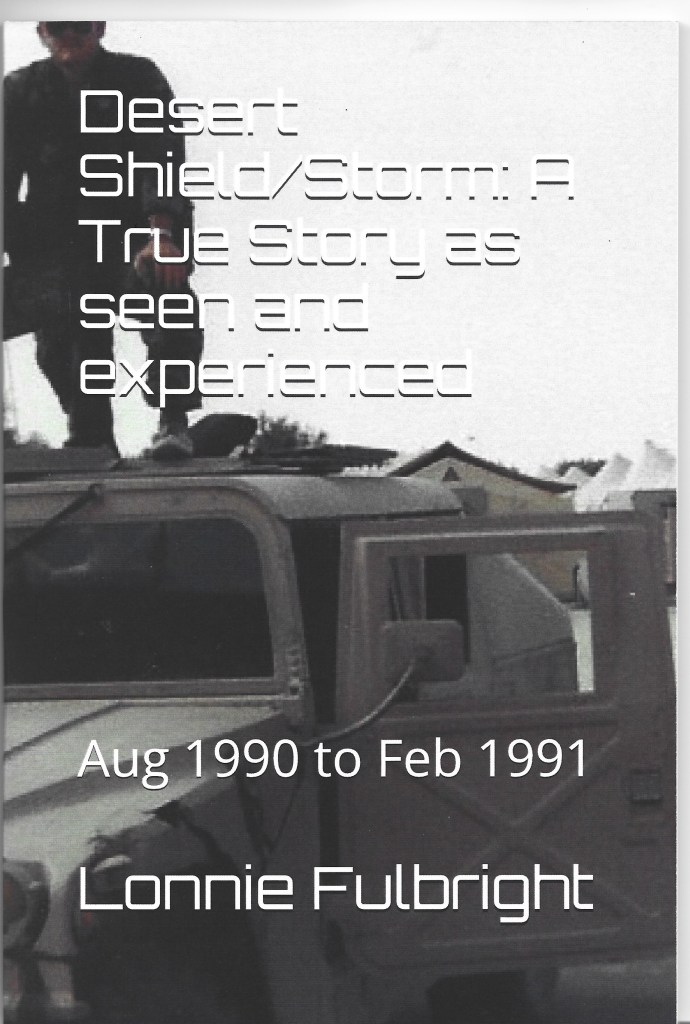
  • Desert Shield/Storm as experienced

    August 13th, 2026
    Desert Shield/Storm by Lonnie M. Fulbright, (Mike).
  • Desert Shield/Storm by Lonnie M. Fulbright, (Mike).

    July 28th, 2026

    Air Soldiers of

    Desert Shield/Desert Storm

    7 Aug 1990-1 Mar 1991

    I remember hearing the sharp piercing wail of the air raid siren as it blasted the alert indicating that we had incoming scuds. I remember getting out of the hummer and watching as the men and women around me put on their gas mask and ran to the bunker for protection. I, however, stood outside and looked up into the clear night sky. I was looking for the scud. At night, it’s easier to see them because they have behind them a fire trail, so we all wait. After a few minute’s we hear the explosion as two patriot missiles, which were fired reach the speed of sound, their target – the inbound scud. We all watch as they climb skyward leaving a trail of fire behind them in route to their target. Then we see the flash and hear the sound as they make impact with the scud body. We all yell and jump around with excitement. However, as we watch the scud warhead plunge to earth, we realize that its trajectory is the north side of the base. Then BOOM … followed by the concussion from the disturbance in the air and the ground shaking. Suddenly the radio is alive as we hear the frantic transmission from Bravo 11. The warhead hit about 200 yards from their location but …

    I want to say thank you to the men and women I served with and especially to Tech Sergeant Ray “Cowboy” Craig who became my best friend in that struggle for anything and everything that would help us make it back to our families in one piece.

    Desert Shield/Desert Storm

    Thursday, Aug 2, 1990.

    Zero six hundred comes early no matter what morning it is and boy do I hate the alarm clock, it’s not the clock so much as it is the time it is set for. So, I get up and boy am I sluggish, especially not being a morning person. But, I do manage to crawl out of bed, get shaved, dressed and make my way to the kitchen where my darling wife has the coffee brewing.

    “Morning babe,” I say as I come up behind her. I pour my first cup of coffee, and begin my day having no idea what was about to unfold, as did no one else for that matter. When I am finished with my breakfast I kiss the wife and go out the door of our on base apartment at Bethel Manor, get in the van and head off to work. It takes me about ten minutes as I go in through the NASA gate. I drive to the office, which is now in the newly constructed office of CSC/SPOS, which happened to be in an old control tower, which we converted. SPOS is on the second floor and Central Security Control, CSC is on the third.

    When I arrive, I am always the first one there, I put the coffee on and go about the business of the day, updating OI’s, or SSI’s or whatever needed to be done as far as paperwork is concerned, just your typical day. Today we are in the second day of an anti-terrorist exercise and at about 09:15 I get a call to go to the LE desk and assist them. I guess it’s because they need an extra man there as a Controller for the anti-terrorism exercise that started yesterday.

    Tech Sergeant Peter Benoit and Staff Sergeant Jeffery Hughey are the Desk Sergeants and as I walk in the main door I say, “Hey, ya’ll what’s up.”

    “Just waiting on this exercise,” Pete said smiling.

    As the morning went on we, just so happened to be listening to the commercial radio … Before I continue let me stop and first introduce a few of the characters.

    My name is Lonnie M. Fulbright. As a kid us boys would use go through the motions of playing war. I loved the old war shows like, Combat, Rat Patrol, McHale’s Navy and so on. When I was 10 years, while living in Mississippi, I decided that when I was 18 I was going to join the Air Force. Then as a teenager from 1968 – 1974 there was the unpopular war in Vietnam, a war I had no idea about.

    I entered the Air Force in 1974 when Vietnam was in its winding down stages. That’s right, I said Air Force. How about that, someone who isn’t in the Army, Navy, or Marines and not a Pilot, I’ll bet you didn’t know that. Yep, the Air Force has heroes that are not Pilots. Yes sir, we the Security Police are the Air Forces ground pounders, Air Base Defenders who operate the same way the Army does. That’s right, we dug holes in the ground, we patrolled, (outside the wire), we killed the enemy and we defended our Air base to the death. Yep, we are just as special as any special forces. Okay, off my soap box.

    I did however, train under that umbrella, I was also introduced to anti-terrorism training. My first assignment was to Griffis AFB, Rome N.Y. There I began my indoctrination to Nuke Security becoming what we eagerly liked being called “SAC Trained Killers.” I went to Germany after that, and then on to the worse place on the earth,

    Grand Forks, which I hated with a passion. Kunsan South Korea was next and finally in 1986 I was reassigned to Langley AFB. There I trained as a Security Controller and Flight Chief. Then In 1988, I was given the job as the NCOIC, that’s Non-Commissioned Officer in Charge, of security sensors, pretty fancy title ain’t it? Then, what the military trains for happened, War. August 1990 Iraq invaded Kuwait and off we went. I deployed with the finest Security Police Squadron that I have ever had the privilege to serve with, to central Saudi Arabia. 

    The following poem gives the US Air Force Security Police a little praise.

    D E F E N D E R S

    The Army has their claim to fame,

    The “Airborne Rangers, The Green Beret”

    The Corps have their elite too

    Recon Patrol, the proud, the few

    The world knows of the Navy Seal

    Life of Danger, Men of Steel

    But when it comes to us, not much is heard

    We’re just Air Force cops who guard the birds

    In Vietnam, through toil and strife

    We gave it all, our hearts, our life

    A page in history, a chapter in time

    We fought for freedom, yours and mine

    We stay vigilant, through cold and rain

    And bear the hardship, fatigue and pain

    This piece of ground we will defend

    Side by side, till the bitter end

    So fear not pilot, you can fly all day,

    This base is guarded by the “Blue Beret”

    Now that I have introduced myself, let’s introduce Raymond “Cowboy” Craig. He is just coming off a short tour and finds himself on the edge of a deployment.  But this one wasn’t just another, run of the mill deployment, no sir, this one was for keeps, we were headed into a place we never expected to go and of course, well, you know.  In the picture below you can see Ray smiling trying to make believe he is a happy camper, he twern’t happy a-tall. No sir, as-a-matter-of-fact, I’d say he was a mite upset. Let’s see what he has to say.

    “On August 2, 1990 I was stationed at Langley AFB in Hampton, Virginia, having just arrived there in May after completing a year-long tour in Korea without my family. I was pretty happy to be at Langley because I’m originally from Virginia and Hampton was only an hour away from my old stomping grounds of Highland Springs, and I also knew that Langley would most likely be my last duty station before I retired from the Air Force.

                   “My family and I had, for the most part, made it through the awkward period of getting reacquainted that always comes after the service member returns home after a remote tour, and were looking forward to the time we were to spend in Virginia,”  He goes on further to say that he was looking forward to the time when he was going to spend with his unit, the 1st Security Police Squadron, because for the first time in his Air Force career he was stationed at a base where there was a Federal Magistrate’s Court nearby, which meant that when we of the Base Police wrote a civilian a ticket.  He couldn’t just wipe his butt with it since the standard AF Form 1408 means nothing to a civilian. But the DD Form 1805/Magistrate’s Ticket, however, was another thing entirely – this was a TRAFFIC CITATION in every sense of the word, points against your license, fines, the whole thing! At Langley I felt more like a bona-fide cop than I ever did before. So I was working the Day Shift as the Flight Chief of “A” Flight and was still trying to get to know the people on my shift and in my unit. I was also, pretty secure in the notion that since I had just completed my second remote tour, the Air Force was going to leave me alone as far as lengthy deployments or reassignments went for at least the next 18 months, because according to regulations that’s how long it was going to be before I was eligible for either. Saddam Hussein changed all that. I was off that day and was at my quarters in the Bethel Manor off-base housing area when the phone rang. I answered it and was told that a base-wide recall had just been initiated; I asked why, and the Desk Sergeant on the other end told me that Iraqi forces had just invaded Kuwait, and Kuwait was screaming for help, so I did exactly what you are supposed to do when you get the “recall” phone call. I stopped what I was doing. I Put on my BDU uniform without bothering to shave or shower or anything like that (time is VERY critical during a recall). I grabbed my pre-packed Mobility Bag containing enough uniforms and personal hygiene supplies for 30 days in the field, kissed my kids and my then-wife Mary good-bye, got in my brand-new blue Chevy S-10 pickup truck I had just bought the month before, and drove to the base to report in. Needless-to-say, the traffic heading into the base was a nightmare, but it was an orderly nightmare.

                   Once I arrived at my squadron area and signed in. I was in turn, sent to the Armory area to wait. Nobody knew what was going to happen since the President of the United States had not decided whether to send troops in or not; seems he wanted to give the Useless Nations a chance to act first. We sat around for about six hours or so and finally given the word – go home and wait for the phone to ring. Normal duty assignments in the meantime, but, be ready to go at a moment’s notice.

    Was I worried? Nope. For two reasons: One, I had just gotten back from a remote tour so I wasn’t eligible for deployment, and Two, I seriously believed that Hussein would back down and pull his troops out of Kuwait. And I spent the next 4 days telling everyone who asked me if I thought we were gonna go “no,” because he’d back down. NO WAY would he risk incurring the wrath of the entire world and especially the United States by remaining in Kuwait. The outcry from the rest of the world, even from the other Muslim states, was universal and deafening, all of them calling for his immediate withdrawal. As the reports of looting, pillaging, burning and raping started to flow in, the calls for his withdrawal turned into demands and finally into ultimatums. But he’d pull out. Sure he would – NOBODY could be THAT stupid. Or so I thought.”

    Okay, on with the rest of the story.

    August 2, 1990:

    News Reports:

    At about 2 a.m. local time Saudi Arabia, Iraqi forces invaded Kuwait, Iraq’s tiny, oil-rich neighbor. Kuwait’s defense forces were rapidly overwhelmed, and those that were not destroyed retreated to Saudi Arabia. The emir of Kuwait, his family, and other government leaders fled to Saudi Arabia as well, and within hours Kuwait City had been captured and the Iraqis had established a provincial government. By annexing Kuwait, Iraq gained control of 20 percent of the world’s oil reserves and, for the first time, a substantial coastline on the Persian Gulf. The same day, the United Nations Security Council unanimously denounced the invasion and demanded Iraq’s immediate withdrawal from Kuwait.

                  I am at the LE desk.

                  “Did you here that?” Hughey said as he turned up the volume on the radio.

                  All of a sudden we started seeing the squadron come to life as people started buzzing around. The news kept reporting and we heard about the reaction from the White House.

    President Bush was not too happy. We heard that he froze all of Iraqi assets, put all military base on alert for deployment, and started making preparations for war. After some talk back and forth we heard that our supply section had started getting some pallets put together and being readied for deployment.  Some thought that we’re going while others thought we wouldn’t.  I personally thought that we would not, that a “Sanction” solution would, as always, do the trick. But this day the radio and TV were alive with all kinds of reports about special meetings with the white house and the U.N. Security Council.

    “Well Sergeant Fulbright, what do you think?”

    “About us going to war, not going to happen.”  

    “Well, all I’ve got to say,” Pete said laughing. “Is can you speak Arabic?” 

    I laughed because I really didn’t believe it.

    “Didn’t you know that Langley, the 1st TFW’s deployment area is the Southwest Asia area, Saudi Arabia to be exact?” Benoit said as he looked up at me.

    My laugh was turning out to be, not just a laugh because something was funny, but because it was just a way to hide the real feeling. Then we heard what everyone at the desk thought was the clincher. The Saudi King, being in fear for his country, requested the protection of the U.S. military. As Bugs Bunny would say, “of course you know this means war.” Oh boy, I think.

     Of course we know it wasn’t about land or the incursion thereof, it was about the oil. We could really care less about the people or the land, but we did care about that oil. So, with all of that said, we can get into this new adventure called Operation called Desert Shield/Storm.

    More Reports:

    2 August 1990: Iraqi Invasion


    The Iraqi attack had been launched at 01:00hrs of 2

    August 1990, with the T-72s and mechanized infantry of the al-Medinah al-Munawera Division rolling over the border south of Safwan and along the Highway 6 towards Kuwait City. There was no opposition: although informed, the royal family and Kuwaiti officials did nothing to warn their armed forces, instead being busy with preparations for a hasty departure. The Iraqis swiftly bypassed the base of the 6th Kuwaiti Mechanized Brigade, and rushed towards south, reaching the outskirts of Kuwait City already by 05:00hrs, few minutes before the dawn. Simultaneously, the al-Medinah al-Munawera Armored Division entered the Rumaylah oilfields and raced towards the south, bypassing the base of the Kuwaiti 35th Mechanized Brigade in the process.

     
    It was only around 05:00hrs that the first Kuwaiti

    Land Forces unit – roughly a battalion of Chieftain Tanks from the 35th Mechanized Brigade, led by Col. Salem al-Srour – has moved out of its base and towards Jahra, with intention of mounting delaying action. At dawn, both sides brought their air forces into action, and it was around this time – shortly after 05:00hrs – that the Kuwaiti air defense units were activated. Shortly before the first wave of IrAF fighter-bombers arrived, two KAF A-4KUs were scrambled from the Ahmed al-Jaber AB. They attacked the front column of the al-Medinah al-Munawera Armored Division, making two strafing passes each, causing little (if any) damage before escaping undamaged.

    Due to chaos and break down of its chain of command – but at least as much due to the fact that none of its Pakistani, Indian and Bengali officers and NCOs that managed the armament and technical support of the KAF units was available – the KAF was not yet able of mounting additional sorties before larger formations of Iraqi fighter-bombers and helicopters reached Kuwait City. This meant that none of KAF was caught literally with its “trousers down”. Nevertheless, there was an active MIM-23B I-HAWK site at Bubiyan Island, controlled by a US contractor, who ordered it into firing action after detecting the first formations of Iraqi aircraft and helicopters approaching.

    Despite the Kuwaitis, subsequently claiming their “SAM-sites” to have shot down up to 14 Iraqi aircraft and helicopters, only two HAWK-kills can be confirmed: a Su-22 and MiG-23BN were shot down while approaching over the northern Persian Gulf at dawn. These two planes belonged to formations that took off from Wahda AB (better known as as-Shoibiyah), and were underway to attack Kuwait IAP, along the route as-Shoibiyah – al-Faw – Kuwait IAP. The Su-22 belonged to the No.109 Squadron, and the MiG-23BN to the No.49 Squadron IrAF, and both fighters were flown by young 1st Lieutenants. Both planes were shot down around 05:00hrs and the Iraqis found no trace of them subsequently. In reaction to activity of the Kuwaiti MIM-23B I-HAWK site at Bubyan, one of Su-22s from the No.109 Squadron IrAF (based at as-Shoibiyah AB), fired a single Kh-25MP anti-radar missile, forcing the site to shut down its radar. Although the IrAF has had Kh-25s since several years, it never used them against Iran, and this was the first combat firing of this weapon ever.

    The results of this strike remain unknown. Later in the day, around 09:00hrs, when Iraqi special units arrived on Bubyan Island to capture the I-HAWK site, they found out that it was set on “automatic” mode of operation. The US contractor had fled, leaving startled Kuwaitis to give up: they have just raised their hands on the sight of the first Iraqi.

    As expected, the base Commander terminated the exercise and called for a high level staff meeting. We were really preparing for a trip to what we called “the sandbox”.

    The news reports kept coming in and what we heard wasn’t good.  It was a confirmation of what was being planned. We got the real deal word through ops, or operations, that the first Tactical Fighter Wing was deploying into the desert along with all the support personnel. That meant that the base had to be secured before they got there which meant, as you can guess, that 116 of us were packing up and, within a few days headed for our South West Asia area. So, in that sound you would in an old Navy movie, “This is not a drill, this is not a drill, all hands man your battle stations. This was the real deal, and being assigned to the HQ element as security, I knew that I was going. All during my career I, along with my fellow security policemen, had practiced for war so, was I excited, yep.  Was I scared, yep, but who wouldn’t be.  We were inexperienced and untested. But letting a war pass me by in my generation and me not be a part of it, notta! I went home after work and told my wife.

  • The Attack on Rebel Station.

    July 27th, 2026

    This is from the book “Rebel Station.” You will find it listed on Amazon.com.

    At 2030, Chung and his men were in the staging area applying the final touches of camouflage paint to their faces.  When they were finished, they silently moved out.

    “Are you ready?” Hathaway asked Pierce as they sat over against the wall.  He pulled out a book and began to read.

    Jake loved his coffee and he loved it strong, night or day, it didn’t matter.  And when it came to sleeping, it didn’t bother him as it did others.  But, on the other hand, he did seem to need it to start his day.  He was watching the men and taking some mental notes.  He was about to take another sip when suddenly the feeling he’d been feeling all day urged him to go outside.  “Good time to make a perimeter check,” he said.  But first, he walked over to the coffee pot and filled up a thermos.

    Kang made his way slowly up to the edge of the east tree line.  There was no clear zone here and he could use the trees to conceal his movements.  He moved silently up until he could see the outline of the bunker to his right.  With the darkness being his friend, he had no problem slipping past it and into the little finger of trees that went into the compound.  He silently moved through until he got to where he could see the open area.  He got down to a knee behind a tree and looked left down the road leading into the compound, and then right.  Seeing no one, he got up, stayed low, and made his way across and into the next wooded area.  From there he stayed near the northern edge and moved another fifty- or sixty-meters further west.  He found a place he could set up that gave him a clear and unobstructed line of sight to the west end of the main building.  He loaded an RPG round, placed the weapon on the ground at his feet, and readied himself with his AK-47, just in case he had trouble.  As he was doing that, he observed a four-man patrol making their way along the west side perimeter.

    Sgt. Fagan and his fire team were making their way across the open area along the west side road.  They had just left the tower at Tango One and their next stop was Bravo Two.

    “It sure is dark out here,” Patterson said, as he looked out beyond the perimeter.

    “Yep, so watch your step,” Fagan said, looking back over his shoulder.

    Jake walked into Rebel Base, picked up the field phone to the bunkers on the north perimeter and spun the crank.  He waited for a response from each one.  “This is Anderson,” he said, “I’m coming out to check on you guys and to bring out some coffees, so don’t anyone shoot.”  He smiled and put the phone back into its case.  He headed back to the squad room.  His flak vest was next to his weapon, and he put in on.  It was the old Vietnam type and all it was really good for was stopping low velocity shrapnel or a rock or something.  He grabbed his weapon and headed for the back door.

    “Be careful out there,” Griffin said.

    Jake smiled and nodded back at him.  “Griff, make contact with Howard and check their status.”

    “Roger that.”

    It was 2130 when Jake stepped outside the back door and into the warm night air.  He took in a deep breath, looked up into the night sky, and, as always, was amazed at the stars.  No moon yet.  That could be a problem, he thought.  As he stood there just outside the doorway, he looked around, then reached into his butt pack and pulled out his Rebel cap, put it on, and smiled.  He listened to the normal night sounds, but the only sound that drew his attention was the low hum of the generator.  He turned his head to the left and looked at it, but what he saw was the shelter that had been constructed around it.  And even though it was supposed to muffle the sound, it didn’t.  He thought, surely, this thing can be heard by someone other than me.  He turned around and looked back into the door, shrugged, and stepped off.

    The trees in front of him were about ten meters away and had an eerie look about them.  During the summer months, they were in full bloom making it hard to see through them.  He thought about the weather and how the rain would be coming in soon.  He hated the rain.  He remembered the rainy season in Vietnam, so he was sure it would be the same here since they were in the same T.O.O. “Theater of Operations.”  He looked to his right and saw the tower of Tango Two.  He cleared his throat and looked back to his left.  He considered going down to the foot path and going around that way, then thought about going by way of Bravo 9.  “Nope, I’m taking a shortcut through the trees.”  Besides, he wanted to stop in the com building and talk to them about radio traffic from other military installations, especially anything that might affect them.

    As Jake walked slowly through the trees toward the com building, he began to have that bad feeling again and suddenly his blood ran cold again.  He stopped instinctively and brought his weapon up.  Death was on the prowl and close.  He could feel it.  He looked slowly around him and then slowly, and cautiously, he continued.  When he reached the other side of the wooded area, he could see the back side of the com building.  On both sides of the building were the antennas. He waited for a minute and saw two men of the security team as they came around the back side of the building.  One of them stopped to light a cigarette, turned, looked at Jake and waved, then went back to his duty.  Both guards had their M- 16s slung over their shoulders, and neither of them seemed to be very concerned or alert.  Rookies, he thought, as he walked around to the front and entered in.

    “Hey, guys.  What’s on the old airwaves?” Jake said, as he went over to one of the operators.

    Staff Sergeant Thomas Roves sat at the com panel monitoring the radio traffic coming in.  He turned to look up at Jake.

    “Hey Jake, how’s it going out there?”

    “Kind of scary,” Jake responded.

    “Well, here’s something that might scare you even more.  We’ve been picking up some chatter that has a strong signal.  It seems to be radio-to-radio in Korean.  I don’t know a lot about the language, but I think someone said in place, another sounded like they acknowledged, and several transmissions about targets, but nothing about what targets.”

     “And you say it sounds local.”

    “Yea, clear, you know.”

    “Any word from the DMZ,” Jake asked, hoping to get some insight.

    “Nothing yet,” said Roves.

    “Okay, thanks,” Jake said and left.  Radio transmissions, and close.  Could mean that they were about to have some very unfriendly visitors.  And you can bet they don’t have Rebel Stations best interest in mind.

    At Bravo 9, Sgt. Vaughn stared at the perimeter.  He was calm, collected, and just as the others, unsuspecting.  He looked out into the darkness that surrounded him.  A slight breeze blew through the tops of the trees and made a rustling sound.  He looked up and had a momentary thought about home.

    After Jake finished his conversation with com, he stepped back outside and for a moment just listened.  The sounds of the night, plus that of the generator, were still all he heard.  He turned back around to look in the direction of the generator.  Even though it was a low hum, it sure did make a lot of noise.  He continued through the open area and could see the backside of Bravo 9 another seventy or so meters in front of him.  With what little bit of light there was, he was glad he could see it, and the ground, because he would hate to stumble and fall.  That would be embarrassing.

    Chung and his men moved silently and undetected into their individual attack positions.  They confirmed they were in place by squelching twice.  Now, they waited.

    Chung still did not understand why the Americans deemed it unnecessary to put out any early warning devises.  That decision would be a costly mistake.

    After he knew his men were ready, he waited for a few seconds, then reached into a small bag and pulled out his infrared spotter scope.  He put it to his eyes and watched the bunker on the northern tip.  That was his target.  He scanned the area immediately around it then refocused on his target.  He could see that it was manned by two personnel, one watching while the other probably rested.  Then off to his left he noticed a soldier walking across the short distance of open area headed toward the bunker.  Chung put the scope back in his bag and slowly picked up his RPG-7V and prepared to initiate the attack, his RPG round hitting his target was the signal to start.

    Sgt. Kyung-gu, just forty meters to Chung’s right waited as well.  He was loaded and would follow up with an RPG of his own.

    Even though Jake was not able to see if someone was in close proximity watching him, he knew they were there.  He knew it because that uneasy feeling was still there and seemed to be getting stronger.  He kept walking slowly toward Bravo 9, scanning the area as he went.  When he got there, he announced his presence.

    “Sgt. Vaughn, I’m coming in.”

    “Come on in,” he said from the front of the bunker.  He had the star light scope to his eye scanning the area along the tree line directly to his north and swinging around to his northeast.

    “See anything?” Jake asked, as he got inside.

    “Nada,” replied Vaughn.  “And very soon we won’t be able to see anything at all, because the batteries are rapidly dying and then we’ll have to wait for fresh ones to come out, if there are any.”

    “I brought some coffee, if anyone needs some.”  Jake came up behind Vaughn and took up his position looking out of the front of the bunker.

    The bunkers were built with three deep sand bagged walls on three sides and a steel grate on top.  The grate was primarily used as a pallet to ship equipment, but now it had another use, as the bunker’s top cover.  It looks pretty sturdy, he thought.  Jake looked out of the gun port and could just barely make out the tree line as branches loomed over the north end of what someone called a thirty-foot clear zone.  He was looking at a spot off to his right when once again his blood ran cold causing the hairs on the back of his neck to stand straight up.  In a split-second, his alert level went to one hundred and ten percent.  Talk about Spidey senses, the second time in less than ten minutes.  It was time to pay close attention.  Something was about to happen.  He knew it.  He picked up the field phone and spun the crank.

    “Go ahead Bravo 9,” Sergeant Allen said.

    “This is Anderson.  Do you have some spare batteries for the scope?  I think I have movement out to my November, and I need to see it.”

    “I’ll see if we can get some out to you.”

    “Roger that.  Also, alert Reaper Actual and the other bunkers.”

    Jake put the handset back in its cradle and tuned his ears back into the sounds of the night.  He listened intently. However, the only sounds he could hear were those of the tree limbs bumping up against each other from the breeze and the chirping of the night insects.  To the rear was the hum of the generator.  He listened even more intently.  He was beginning to feel very edgy and after another minute, he walked out the back of the bunker and went around to its right side.  He stopped and stood there, looking around.  He had his GAU in his right hand holding it by the heat guards, and after a few more seconds, he brought it up to port arms, chambered a round and waited.

    The two men inside the bunker heard the bolt of Anderson’s weapon as it was jacked back and let go, slamming a round into the chamber.

    “Everything okay out there, Sergeant Anderson?” Vaughn yelled.

    Jake could feel the adrenaline rush through his body as he slowly scanned the tree line. “Something ain’t —” he started to say ‘right’ when all of the sudden something caught his eye. It was just a glimmer.  Maybe his imagination, maybe a spot of water on a leaf, but no matter, his attention was focused on that spot in the northeast portion of the tree line.  Extreme danger was out there.  He knew it.  I know you’re there.  “Anyone got any slap flares?” Jake asked, as he looked intently out into the tree line some thirty meters away.  He still hasn’t heard Rebel Base transmit to Reaper Actual.  “Ring up Rebel Base again.”

    Inside Rebel Base, Sergeant Allen was working on his daily blotter when the buzzer on the switchboard sounded.  He looked over at it and saw that it was Bravo 9.  He picked up the handset and put it to his ear. “Sergeant Allen,” he said.

    “This is Vaughn.  Sergeant Anderson is with us, and he believes he has movement, a contact to my November.  Alert the positions and alert Reaper Actual.”

    “Copy that.”  This time Allen picked up the handset and transmitted.  “Reaper Actual, this is Reaper Main, over.”  He waited for a response and then repeated it. “Reaper Actual, this is Reaper Main, over.”

    Down below at the Reaper Actual camp, Hammer was monitoring the radio when he heard the call.  He pulled the handset out of its cradle and replied. “Reaper Main, this is Reaper Actual.  Go ahead with your traffic, over.”

    “Reaper Actual, we have a possible contact outside the perimeter at Bravo 9.  Be on the alert, over.”

    “Reaper Main, I copy, possible contact outside Bravo 9.”  Hammer went over to Sergeant Howard and Steel and told them.

    “Get the men ready to move,” Howard said.

    Down at Comm the radio was alive with activity. From every Army Post and base in South Korea, there were reports of attacks. The Lieutenant and his men all knew that this had to be the prelude for the upcoming attacks. They wrote down as much information as they could.

    “We have got to get this information to the captain.” Said one of the Sergeants.  

    Lei Chung looked at his watch, one minute to attack.  He slowly raised the RPG-7V up to his shoulder and looked through its infrared scope with passive night sight, putting the bunker in its crosshairs.  From where he was, he could see between the trees and had a straight, unobstructed shot to his target.  He was prepared to shoot when he saw a figure step out from the rear of his intended target.  The man stopped, brought his weapon up to his chest and stood there.  Chung froze and stared back at the man.  The man didn’t move.  He just stared at the spot where he was.  He began to press on the trigger, but for some reason he didn’t fire.  He waited.  Jake stood there motionless for another thirty seconds.  Chung stayed motionless as well, watching and waiting.  Another thirty seconds passed.

    “Do you think the batteries have at least ten or twenty seconds of power left?  I need to get a look at that tree line,” he yelled back at Sgt. Vaughn.

    “They just died, and now we are basically blind,” Vaughn said, as he stepped out the back of the Bunker and looked at him.

    “All the positions have been notified.”

    “Good.  I’m going back to the main building to alert Griffin’s team and tell the captain.” Jake quickly walked off.

    Chung continued to watch the man who seemed to know exactly where he was.  Then the man turned and began to hurriedly walk away.

    At Bravo 10, Sergeant Masters and Airman Peterson were manning an M-60 machine gun and watching the northeast tip.  As far as they could see, however, was to the edge of the clear zone.  Beyond that it would take some light, which, if they had a scope, it wouldn’t be a problem.

    “Man, I can’t see a thing,” Masters exclaimed, with some irritation.  “I guess we’ll have to rely on our keen eyesight and super sense of smell.”

    At Bravo 11, Senior Airman Torrelo and Airman Johnston were covering to the west.  There was nothing out there and they didn’t expect anything to be.  Torrelo got down, pulled out a heat tab, and began heating some water to make some coffee.

    Sgt. Richards and A1C Brown in Bravo one viewed the same thing as Bravo 12, only they were seventy meters further south.

    “See anything?” Brown asked.

    “Nope, nothing out there but the dark,” Richard said squinting.

    It was time.  Lt. Chung took careful aim at his target, pulled the trigger, and …

  • July 25th, 2026

    Advertising Books on Amazon.com

←Previous Page
1 2

Blog at WordPress.com.

Loading Comments...
  • Subscribe Subscribed
    • THE DEFENDER
    • Already have a WordPress.com account? Log in now.
    • THE DEFENDER
    • Subscribe Subscribed
    • Sign up
    • Log in
    • Report this content
    • View site in Reader
    • Manage subscriptions
    • Collapse this bar