Skip to content
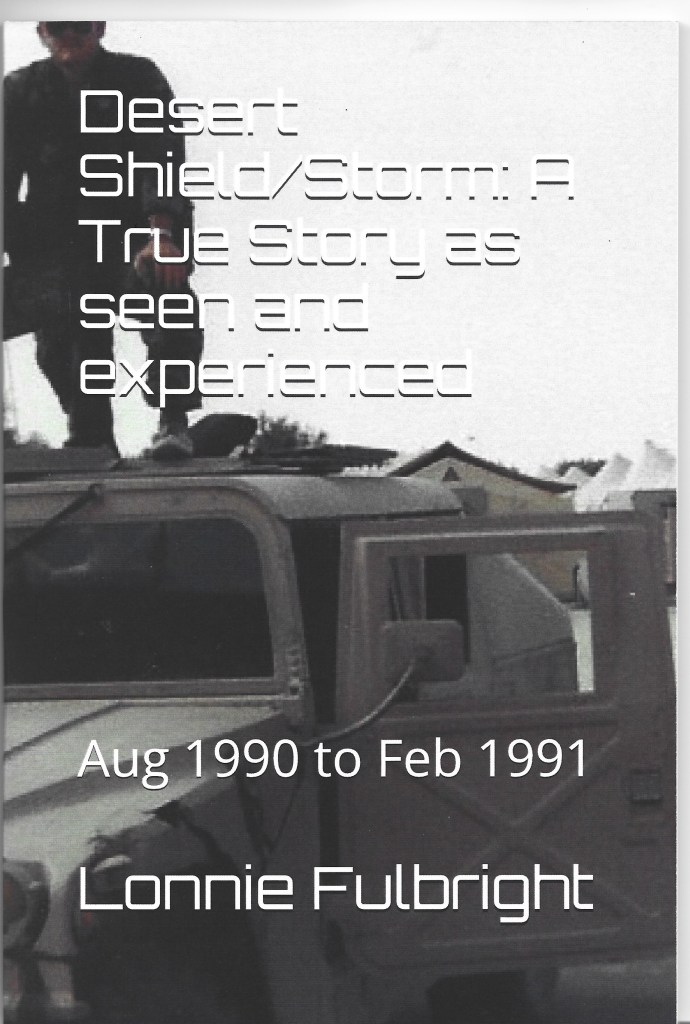
    • Books By Lonnie (Mike) Fulbright at Amazon.com
    • Email

THE DEFENDER

  • Podcast Episode: Desert Shield Storm Memories

    August 28th, 2026

    Pip: THE DEFENDER is back, and today we are going to Saudi Arabia in 1990 — cargo nets for seats, 113-degree air, and a security operation being built from scratch before anyone knew how it would end.

    Mara: lonnie fulbright has been documenting Desert Shield and Desert Storm as lived experience — the arrival, the buildup, the journal entries, the waiting. That is the territory we are covering today.

    Pip: Let's start with the firsthand account of what it actually felt like to be there.

    Gulf War: Ground-Level Accounts of Desert Shield and Storm

    Mara: The question these posts put on the table is a serious one — what did Desert Shield and Desert Storm actually look like from inside them, not from a historian's remove, but as someone living through the uncertainty day by day?

    Pip: And the framing of the first post does the work immediately. The title names the author directly: "Desert Shield/Storm by Lonnie M. Fulbright (Mike)" — that parenthetical nickname signals this is personal. A human being, not a unit designation.

    Mara: The post opens with Tech Sergeant Ray "Cowboy" Craig, in his own words: "I stopped what I was doing. I Put on my BDU uniform without bothering to shave or shower or anything like that (time is VERY critical during a recall). I grabbed my pre-packed Mobility Bag containing enough uniforms and personal hygiene supplies for 30 days in the field, kissed my kids and my then-wife Mary good-bye, got in my brand-new blue Chevy S-10 pickup truck I had just bought the month before, and drove to the base to report in."

    Pip: What that quote captures is the gap between the life you were living thirty minutes ago and the one you just entered. A new truck, a family, a retirement plan — all of it receding in the rearview.

    Mara: Craig had just returned from a year in Korea. Regulations said he was ineligible for another lengthy deployment for eighteen months. He spent four days telling everyone they were not going. Back at the Law Enforcement desk, a commercial radio was on when the news came in — and the laughter that followed, the post notes, was partly a way to hide what everyone was actually feeling.

    Pip: The post is structured as a dual memoir — the narrator's morning running alongside Craig's recall. It also includes the poem "DEFENDERS," making the case that Air Force Security Police were ground soldiers — outside the wire, digging holes — not pilots, not support staff.

    Mara: And it ends mid-sentence, after the warhead lands two hundred yards from Bravo 11's position. Which feels less like an oversight and more like the shape of how memory actually works.

    Pip: Some stories don't resolve. They just have the concussion and the radio coming alive.

    Mara: The continuing account — the post titled "Desert Shield/Storm continued" — picks up on the other side of that aircraft door. The door opens in Saudi Arabia at 113 degrees with ten percent humidity, and the first thing visible from the ramp is sand in every direction. One soldier behind Ray summed it up: "Man, this is the last place I wanna die."

    Pip: Not despair exactly — the kind of dark honesty that keeps people functional when the situation is genuinely grim.

    Mara: By August 9th, 116 personnel were spread across Alpha, Bravo, and eventually Charlie sectors — flight line, fighter area, command, supply, operations. The supply section's motto was already in full effect: "Nothing is too good for the troops and nothing is what they get."

    Pip: A brand-new barracks building already falling apart in real time is somehow the perfect metaphor — everything assembled fast, under pressure, held together by effort rather than quality.

    Mara: Episode Four of the series goes deeper into the buildup. The journal entry for August 16th records the section NCO briefing his team outside BDOC: "Alright gentlemen, suspect everything and trust nothing. If it even looks suspicious, call it in. Monitor your radios and keep a watchful eye."

    Pip: That is the whole job in four sentences — delivered after almost no sleep, at 06:30, in approximately 110 degrees.

    Mara: By August 18th, the official start of Desert Shield, C-5s, C-141s, and contracted commercial planes were landing around the clock. The post eventually names 484 security personnel assigned to the operation, roughly half in the anti-terrorist section. Call signs multiplied — Golf designations for the early critical posts, then a full Charlie sector chart with mobile fire teams and entry control points.

    Pip: And a patrol route affectionately called "13 Miles to Nowhere," which probably deserved a better name but got the job done.

    Mara: The post is candid about command friction — machine gun positions placed on the wrong side of a divided road, Hummer doors removed for tactical egress, ordered back on, eventually removed again. Decisions the NCOs questioned but could not override. And then on September 29th, out on the far perimeter, two men on patrol have a conversation about faith — right after being briefed on an expected attack window of October first through fifth.

    Pip: The journal format makes that land differently than any history book would. The writing here is the archive — and the people who were there are the primary sources.

    Mara: What stays across all of these entries is the texture: earplugs, cargo nets, a pallet of sleeping bags nobody would give up, and one NCO keeping track of all of it.


    Pip: The waiting, the heat, the improvisation — Desert Shield gets equal billing with the combat phase in these posts, and that ordering tells you something about what the writer thought mattered.

    Mara: Firsthand accounts carry weight that secondary sources cannot replicate. More of the record next time.
  • Podcast Episode: Desert Shield Storm Patrol Logs

    August 28th, 2026

    Pip: THE DEFENDER — where the desert is hot, the MREs are deeply suspect, and the duty roster never sleeps.

    Mara: Today we're following one security patrol's firsthand account of Operation Desert Shield and Storm — from bunker construction and bomb threats through the final countdown to January 15th. This is lonnie fulbright's account, written from inside the wire.

    Pip: Let's start with the gates, the sandbags, and the so-called Rangers guarding the pool.

    Gates, Bunkers, and the Long Wait for War

    Pip: These journal entries span roughly four months — late September 1990 through the eve of war — and the question running through all of them is what it actually feels like to watch a deployment shift from tense routine into something with a deadline attached.

    Mara: Episode five sets the baseline. Intelligence in early October reported expected attacks between the first and fifth, and the response was concrete and immediate: "Defense just got intensified. We started building bunkers on every gate and setting up additional 60 machine gun pits at Strategic points. We also placed a four-man fire team behind the Pilot's quarters. Intel has it that Terrorist, have been seen in and around the base with some possible Shootings."

    Pip: So this isn't ambient unease — it's sandbags, machine gun positions, and credible intelligence about people already inside the perimeter.

    Mara: And yet the journal holds both registers at once. The same entries logging bunker construction also describe the MRE game — "Win, Lose, or Draw" — where you pick from a fresh box, keep it or gamble on the old one, knowing the Chicken-a-la-King, nicknamed "Chicken-a-la-THING," is somewhere in the pile.

    Pip: Morale management disguised as a game show. Respect.

    Mara: Episode five also gives us the self-described Air Force Rangers — a unit deactivated after Vietnam — whose commander assigned them pool guard duty and interior recon despite, as the journal notes, an inability to read a grid map or compass. They missed their own pickup point by four hundred meters.

    Pip: The pool. They were guarding the pool.

    Mara: Episode six, covering October through November, picks up that same pattern of routine and genuine danger running side by side. A suspicious bundle at Tent City gets EOD called out. A British soldier is nervous about breaking the Humvee. A bomb threat evacuates the barracks at 20:00 and is cleared by 22:15 — and command's response is to ban radios on post.

    Pip: Out of that friction comes the BROC — the Bureau of Rock Operations Command — when Sgt Twiggs picks up a rock and argues it has more decision-making intelligence than the base operations center. Which is a very portable grievance.

    Mara: Episode six is also direct about what that command distrust looks like from the field: "The commander and his officers don't trust the NCOs, and the NCOs don't trust the officers and those who are in the field. The ones in the field are the ones who know what's going on and should at least be consulted about what will work."

    Pip: That tension never resolves — it just gets overtaken by events. November 30th, the UN Security Council votes unanimously, and Saddam has until January 15th to vacate Kuwait.

    Mara: And episode six closes on what had become the unit's greatest fear going into whatever came next: "We have heard and it has become our biggest fear was that of Chemical use. We don't know to what extent."

    Pip: That's where October and November leave things — mid-preparation, mid-dread.

    Mara: Episode seven picks up December into January, and the register shifts. By day 117 in country, Iraq is test-firing Scud missiles, and the base has quietly forgotten it's in a potential combat zone: "Everyone had gotten set into a routine and seemed to forget that we were in a potential combat zone and stopped expecting anything to happen. So as the weeks went by and into one month then two, all of their protective gear got pushed farther and farther back, they stopped carting it and finally no one had any idea where it was."

    Pip: So when the Scud report came in, the base essentially had to rediscover that it was deployed to a war zone.

    Mara: People in tent city panicked, ran for a back fence, found a single-person gate, and began trying to tear the fence down. Security Police arrived, confirmed the missiles weren't aimed at them, and immediately ordered all gear carried at all times from that point forward.

    Pip: The entries through late December track the texture of waiting — a Christmas tree in the bunk room that made homesickness worse, a false alarm air raid siren on the 21st, another Scud test on the 26th, which happened to be his son Andy's birthday.

    Mara: By New Year's Eve, LP/OP positions are being added and random vehicle searches run every two hours. Then the January entries count down explicitly: six days, five days, four. AT&T cuts phone service on the 14th. The last call home is logged at 3:46 in the morning.

    Pip: And January 14th closes the entry plainly.

    Mara: "War starts tomorrow. Ready or not here it comes. On this day Dhahran went from a hazardous duty zone to a combat zone."

    Pip: Four months of log entries, and that's where they land — at the edge of something the next entry will have to describe differently.

    Mara: What makes this account worth following is exactly that: it was written down as it happened, in real time, before anyone knew how it ended.


    Pip: Bunkers going up, a rock with more authority than command, and a last phone call at 3:46 a.m. — that's a deployment in miniature.

    Mara: The next entries pick up on the other side of January 15th. The diary doesn't stop there.

    Pip: We'll be here when it does.

  • Podcast Episode: Desert Shield/Storm Ep 5

    August 28th, 2026

    Pip: THE DEFENDER — where the desert is hot, the MREs are questionable, and the duty roster never sleeps.

    Mara: Today we're in the middle of Operation Desert Shield, following one security patrol's daily grind through late September and early October 1990 — the threat assessments, the small absurdities, and the moments that turned serious fast. This is lonnie fulbright's account, written from the inside.

    Pip: Let's start with the gates, the bunkers, and the so-called Rangers guarding the pool.

    Desert Shield: Gates, Bunkers, and the Pool Detail

    Mara: Episode five of this Desert Shield journal covers roughly two weeks of night-shift security patrols — late September into mid-October 1990 — and the picture it builds is one of escalating threat alongside the ordinary friction of military life.

    Pip: The threat escalation is real and specific. Intelligence reports expected attacks between October first and fifth, and the response was immediate and concrete.

    Mara: The post puts it plainly: "Defense just got intensified. We started building bunkers on every gate and setting up additional 60 machine gun pits at Strategic points. We also placed a four-man fire team behind the Pilot's quarters. Intel has it that Terrorist, have been seen in and around the base with some possible Shootings."

    Pip: So this isn't abstract tension — it's sandbags, machine gun positions, and credible intelligence about people inside the perimeter. The stakes are physical and immediate.

    Mara: And yet the journal holds both registers at once. The same entries that log bunker construction also describe the MRE game — "Win, Lose, or Draw" — where you pick from a fresh box, keep it or gamble on the old box, knowing the Chicken-a-la-King, nicknamed "Chicken-a-la-THING," is lurking somewhere in the pile.

    Pip: Morale management disguised as a game show. Respect.

    Mara: The October sixth through seventh entry logs a vehicle stop — a car matching a BOLO description, detained near key locations, with OSI and bomb dogs responding. Nothing came of it, but the machinery of a real security response is all there.

    Pip: Then there's Captain Hopper, who dismantled a bunker that A1C Wagner and Rogers spent five days building — rather than have his own people fill sandbags. Wagner and Rogers responded by building a better one.

    Mara: The October eleventh entry closes with a genuine incident: a lone individual carrying an AK-47 enters a bank on base. The patrol responds, establishes a 360 perimeter, and waits for Saudi Police who never arrive. Command calls it off — the bank was closed, the person was probably police.

    Pip: Probably. Very reassuring.

    Mara: But the entry that lands hardest involves the self-described Air Force Rangers — a unit deactivated after Vietnam — whose commander assigned them pool guard duty and interior recon patrol despite, as the journal notes, an inability to read a grid map or compass. They missed their own pickup point by four hundred meters.

    Pip: The pool. They were guarding the pool.

    Mara: The journal's tone throughout is dry and precise — the kind of account that trusts the facts to carry the weight, and mostly they do. What's remarkable is how naturally the serious and the mundane sit side by side in the same shift log.


    Pip: Bunkers going up, Rangers who can't read a compass, and an MRE nobody wanted — that's a deployment in miniature.

    Mara: The next entries will keep moving through October. There's more perimeter to walk.

  • Podcast Episode: Desert Shield/Storm Ep 7

    August 28th, 2026

    Pip: THE DEFENDER — where the history that usually stays in a footlocker gets its own RSS feed.

    Mara: This episode covers lonnie fulbright's ongoing firsthand account of Operation Desert Shield and Storm — a diary from Dhahran as the January 15th deadline closes in. Let's start with the final weeks before war.

    Desert Shield/Storm Ep 7

    Pip: This entry covers roughly six weeks — December into January — when the question stopped being "will war happen" and started being "how many days until it does."

    Mara: The entry opens on December 3rd, day 117 in country, with Iraq test-firing Scud missiles. The diary captures what that moment revealed about the base's readiness: "Everyone had gotten set into a routine and seemed to forget that we were in a potential combat zone and stopped expecting anything to happen. So as the weeks went by and into one month then two, all of their protective gear got pushed farther and farther back, they stopped carting it and finally no one had any idea where it was."

    Pip: So when the Scud report came in, the base essentially had to rediscover that it was deployed to a war zone.

    Mara: That's exactly what the entry describes. People in tent city panicked, ran for a back fence, found a single-person gate, and began trying to tear the fence down. Security Police arrived, confirmed the missiles weren't aimed at them, and Boomer immediately ordered that all gear would be carried at all times from that point forward.

    Pip: Nothing sharpens a gear-accountability policy like a fence that won't cooperate.

    Mara: The December 5th entry adds another layer — an official announcement that the 1st TFW would stay six months unless war started, at which point they'd stay until it ended. The Security Police response to that was direct: "We knew that if war were to start we would fight to the last man, the last bullet, our last breath and we would make the enemy pay dearly for his actions."

    Pip: That's not bravado. That's a unit that has done the math and accepted the answer.

    Mara: The entries through late December track the texture of waiting — a Christmas tree in the bunk room that made homesickness worse, not better, an air raid siren on December 21st that turned out to be a false alarm, another Scud test on December 26th, which happened to be his son Andy's birthday.

    Mara: By New Year's Eve, defensive posture is expanding — LP/OP positions added, random vehicle searches every two hours. The January entries count down explicitly: six days to war, five days and counting, four days.

    Pip: The January 12th entry notes that AT&T cut phone service on the 14th. The last call home, logged in a diary, at 3:46 in the morning.

    Mara: And January 14th closes the entry plainly: "War starts tomorrow. Ready or not here it comes. On this day Dhahran went from a hazardous duty zone to a combat zone."

    Pip: The next episode is going to be a different kind of diary entry entirely.


    Mara: Six weeks of a countdown, written down as it happened — that's what makes this account worth following.

    Pip: The next installment picks up on the other side of January 15th. We'll be here.

  • Desert Shield/Storm Ep 7

    August 28th, 2026

    Mon 3 Dec 1990:

                  As of today we have been in country for 117 days.  And nothing has happened until now.  Today, Iraq fired some scud missiles in the direction of Syria and Israel.  All of them fell inside of Iraq which makes us think that Saddam is testing them to make sure they are operational so that when it comes time to use them, he will use them. He has of course threatened chemical warheads.  Now, let me tell you about this missile firing and the reaction of the people (Military) here at Dhahran.

                  We are working and I’m not sure what sector I was in, but we got the report that the missiles had been fired.  Everyone, other than us, that heard the initial report of the missiles being fire, and not prepared chemically, thought they were fired at us.  But before I go into this let me give you the attitude that had developed over the months since August.  The order of the day was business as usual, as if we were at home at Langley AFB.  Everyone had gotten set into a routine and seemed to forget that we were in a potential combat zone and stopped expecting anything to happen.  So as the weeks went by and into one month then two, all of their protective gear got pushed farther and farther back, they stopped carting it and finally no one had any idea where it was.  There are exceptions, the Combat oriented Security Police.  We have always carried our gear no matter what. Even stateside we had it so it wasn’t anything different here.  Meanwhile, after the missiles were fired, everyone living in tent city – not affiliated with our particular career field and not having their gear, panicked and began running for shelter.  Behind tent city there was a fence, and that fence had one exit, a single person gate. There was also an exit to the front, which by the way was the way that everyone entered and exited tent city, but everyone, instead of running to the main entrance, ran to where there was that small opening in the fence.  The results were a commencement of trying to tear down the fence, but to no avail.  Finally, after the security police arrived to tell everyone that the missiles were not aimed at us, order was restored.  When this news got to Boomer he ordered, from this day forward, that everyone will have all their gear, with them, at all times.  It was really funny.

    Wed 5 Dec 1990:

                  Today we received another official announcement; the 1st TFW will be here for 6 months unless war starts, and if that happens we will be here until the end of the war.  It turned out to be March.   The Security Police mentality changed from that point. We were told from the beginning that the attacks we would most likely be subjected to is, from terrorist, or Special Forces type so, we figured, that, if we were going to be in a fire fight, then we would go down in a blaze of glory.  What is ironic is that “Bon Jovi” came out with a song that became one of the most requested songs on AFRN, “Shot Down in a Blaze of Glory.” We knew that if war were to start we would fight to the last man, the last bullet, our last breath and we would make the enemy pay dearly for his actions. Death.

                  Christmas time was coming and the room Ray and I were in bunked most of the guys we worked with and they had it all decked out with a small Christmas tree and lights.  Trying to bring a little bit of home to our lives was with good intention but made us miss it even more.  And then;

    Sat 15 Dec 1990:

                  Today everyone in our room was told we were vacating and being dispersed among the other rooms. Ray and I were told that we were moving to the room where BDOC is bedded down.  We were not sure why and with a little reluctance, we did.

    Fri 21 Dec 1990:

                  1000 hours the air raid siren blasted indicating that we had possible incoming.  Those who were asleep were awakened and everyone donned all their gear and headed down to take shelter.  At around 1030 it was terminated and called a false alarm.

    Sun 23 Dec 1990:

                  Jingle bells jingle bells, jingle all the, Ho-Ho-Ho, Merry Christmas and with that we received a very special gift, we are back in 12’s, this time from 8pm to 8am.

    Wed 26 Dec 1990:

                  Andy, my son’s, birthday and it was announced by the air raid siren indicating that Saddam tested another Scud. Once again we put on all of our gear and waited.  There was now no doubt about it, we were for sure going to WAR!

    Mon 31 Dec 1990:

                  Today we strengthened our defenses by adding Delta 1-5 plus Charlie Whiskey-1, all inside the off base POL area.  Each Delta is an LP/OP. The commander wanted some early warning as to possible penetration attempts.  The strategy sounds good.

                  All this has to do with us just wanting to go home.  It is the frustration that drives this next thought. Here is what we think, and has been proven, to be the justification for more troops. You have to add more post than can be filled with current man power, thus, additional personal needed.  And Col Pack did just that and got what he needed.  Every time he wanted more men he added more post.  Example; when no more troops were coming in he decided he wanted airport security, it didn’t happen, then when the President came for thanksgiving he thought he could use Hickam AFB, but Prince Turkey said no.  Then he had to put us into 8 hour shifts. But Col. Pack wasn’t through yet.  He thought and thought and then it came to him, the Defended Locale plan.  Vaa-la, more post equals more men equal’s 12 hour shifts.   But with the 15 Jan deadline I guess it makes since.  Here is another anti-terrorist measure; CM-3 is now Special Post 3 & 4, both doing random vehicle searches at different locations every two hours.

    Thur. 10 Jan 1991: (6 days to War)

                   The defended locale has been put into effect, and 6 Iraq helicopters defected, Saddam not vacating Kuwait.

            Fri 11 Jan 1991: (5 Days and counting)

                  Threat-Con Charlie implemented which puts in a two flight concept.  That means 116 posts during the day and 116 for night.  Additional bunkers that had previously been built are now being manned and the patrols are concentrating now on vulnerabilities.  We are confident that we will deter and defend.

    Sat 12 Jan 1991: (4 days and counting)

                   It started raining today at about 21:00.  I made also made my last phone call for a while.  ATT will cut the service on the 14th.  Congress also approved use of force after the 15th.  It is 03:46 and we are three days away from War.  Everyone here is excited and apprehensive at the same time.

    Mon 14 Jan 1991:

                   War starts tomorrow.  Ready or not here it comes.  On this day Dhahran went from a hazardous duty zone to a combat zone.

  • Podcast Episode: Desert Shield/Storm Ep 6

    August 28th, 2026

    Pip: THE DEFENDER — where history gets written one patrol log at a time, sometimes in the dark, sometimes three hours after a bomb threat cut your sleep short.

    Mara: Today we're in the middle of lonnie fulbright's firsthand account of Desert Shield, covering October through November 1990 — command friction, field-level ingenuity, and the moment war stopped being hypothetical.

    Pip: Let's start with the log entries themselves.

    Desert Shield/Storm: October–November 1990

    Mara: This episode of the series drops us into a stretch of weeks where routine and genuine danger run side by side — suspicious bundles, bomb threats, battle plan rumors, and a command structure that the people on the ground have very little faith in.

    Pip: The suspicious bundle at Tent City sets the tone early. EOD gets called, the scene gets locked down, and a TSgt on site apparently just wanted to walk over and pick the thing up.

    Mara: The post puts it plainly: "If he did, and it was a bomb, then we would have sent his pieces back home in a plastic bag."

    Pip: That is the entire case for EOD protocol, delivered in one sentence.

    Mara: What follows across October is a pattern — short, clipped log entries where nothing happened, then entries where quite a lot happened. A British soldier gets to drive the Humvee and is nervous about breaking it. Captain Christian briefs the unit on a proposed battle plan to let Saddam's forces advance to within 110 miles before cutting supply lines. The troops on the ground think that's a mistake.

    Pip: Then on the 19th, a bomb threat evacuates the barracks at 20:00, and by 22:15 it's over — and somehow BDOC's response to all of this is to ban radios on post.

    Mara: The post is direct about what that friction looks like from the field: "The commander and his officers don't trust the NCOs, and the NCOs don't trust the officers and those who are in the field. The ones in the field are the ones who know what's going on and should at least be consulted about what will work."

    Pip: Out of that frustration comes the BROC — the Bureau of Rock Operations Command, essentially — when Sgt Twiggs picks up a rock and argues it has more decision-making intelligence than BDOC. Which, to be fair, is a very portable grievance.

    Mara: The rock makes it all the way to a post check with Captain Christian and SMSgt Green, who are not amused. Repercussions are expected.

    Pip: November shifts the register. Mobile Reserve duty is boring — sitting in tents, engine noise from a test cell out back — but Thanksgiving week brings real training: PRC-77 tactical radio, calling fire from an AC-130, NVGs, LAW rockets, claymores.

    Mara: And then November 30th. The shift schedule had just changed to eight-hour rotations — a rare good call from command — when Washington made it official. The post records the deadline: Saddam has until January 15, 1991 to vacate Kuwait, with the UN Security Council voting unanimously that military force would be used if necessary.

    Pip: The entry doesn't pretend the stakes are simple. It names oil as the real driver, alongside the stated rationale, and closes on what had become the unit's greatest fear going into whatever came next.

    Mara: "We have heard and it has become our biggest fear was that of Chemical use. We don't know to what extent."

    Pip: That's where the log stops — mid-preparation, mid-dread, waiting for January.


    Mara: Thirty-five years on, these log entries still carry the texture of what waiting for war actually felt like — the boredom, the friction, the specific fear.

    Pip: Next time, the deadline gets closer. We'll see what the log says when it does.

  • Desert Shield/Storm Ep 6

    August 28th, 2026

    Charlie Mike-1 with Simmons.  At 02:30, (14 Oct), we responded to tent city for a suspicious bundle.  Kilo-4, SSgt Bullard, and EOD, came out and checked it out.  It turned out to be just a bundle of papers.  In this process there was a TSgt in charge of the security at Tent City, who could not understand why we were making such a fuss over this bundle of papers.  But of course he should have been the one who called it in not us.  And he just wanted to go over and pick it up.  If he did, and it was a bomb, then we would have sent his pieces back home in a plastic bag.

    Sun 14 Oct 1990:

    Charlie Mike-8 with Accender.  Nothing out of the ordinary happened on this date.

    Mon 15 Oct 1990:

                  Charlie Mike-3 with Iwaskiewicz (Hammer). We conducted battery change and then went out, by request of Captain Stavaski, to let a Brit drive our hummer.  He was a little bit afraid and said he didn’t want to break it. We told him to have fun.  Notice the mounds in the back ground.  These and some just like them became our playground, especially at night.

                  Captain Christian came out and told us about a proposed battle plan for the U.S.  She said that the U.S. was going to let Saddam’s forces move to within 110 miles of us and then we would cut off his supply lines.  Of course we thought it would be a mistake because once he got his momentum we’d play havoc trying to stop him.  The rest of shift we just talked about it but didn’t let that bother us.

    Fri 19 Oct 1990:

                  CM-1 with Dennis. As you see I haven’t written in a couple of days because it is all starting to be routine.  But before we came to work we were awakened and told that a situation was in progress.  20:00 we were evacuated because it was bomb threat.  We only had about three hours of sleep and then at 22:15 it was over and we were at work.

                  BDOC is at it again.  Our commander found out that we have radios on post and Due to our Commands infinite wisdom we now can’t have radios on post.  Radio’s that they know about that is.  We are also to wear flak vest and helmets at the ECP’s (Good move).

                  I really think that there is a power struggle between BDOC and command structure.  It seems that no one has any trust or confidence in each other.  The commander and his officers don’t trust the NCO’s, and the NCO’s don’t trust the officers and those who are in the field.  The ones in the field are the ones who know what’s going on and should at least be consulted about what will work.  But instead, the chair born rangers, or arm chair quarterbacks will make a decision based on their own personal power and that’s it.  It doesn’t matter if it will really work or not.  Just don’t it because.

    Sun 21 Oct 1990:

                  CM-3 with A1C Brown.  As we made our rounds conducting post checks we met up with the patrol that Sgt William Twiggs Jr. was assigned to. Sgt Twiggs, from Whiteman AFB, and I came up with something that gave us all a laugh. He reached down and picked up a rock, which I still have by the way, and the “B.R.O.C.” was born.  Sgt Twiggs, after picking up the rock, made a comparison between the intelligence of that “Rock” and “BDOC”.  He said that this rock has more intelligence. This is because that the rock can make the same decisions and with more intelligence.  It was funny.  It would still be funny even after the next account.

    Wed 24 Oct 1990:

                  I don’t remember which patrol I was on but we heard that SMSgt Green and Captain Christian were on a post check and were out on CE-3. It just so happened that Sgt Twiggs and Sgt Greg Hamlin were on this post.  When asked how he was doing, Sgt Twiggs, in his usual jovial self, commenced to give them a rundown concerning the “ROCK”.  Neither the Captain, nor SMSgt Green liked what they heard.  But what the hey, it was only a rock. We did expect repercussions.

    Thur. 25 Oct 1990:

                  General Horner made a visit to the barracks and BDOC was jumping through hoops to impress him.

    Sun-Wed 28-31 Oct 1990: Mobile Reserve Duty.

     Our time posted as Mobil Reserve Force duty was a boring time.  All we do is sit around in the tent and then do some training and then sit in the tent and then, and then, and then. There was an engine test cell to our rear that was always running one up and man was it loud but, we did get to listen to the radio.

     Hey here is something.  I am of course retired and now live in Macon, Ga.  In 2007 I started working at Robins AFB as a guard on the gates.  During that time a man came in and became our boss, His name was Sanders Harris.  Funny thing is, he was a TSgt with me at Dhahran and he was assigned to the Viper section and was in Viper Base, which was, as you look at the picture of the Mobile reserve tent, the tower he was in was to the right. Now he calls me “Lonnie Legend” because I have him on paper saying he was actually there.

    Thur. 1 Nov 1990:

                  CM-1 with SSgt Nava.  We are gearing up for war.  We heard on the radio that there will be no rotations and that all ground forces will be in country for the duration of the war.  Happy are we.  Can we win? You better believe it, and not only can we win, but we will win.  Saddam has done bitten off more that he can chew.  The USAF is going to win the war before it even starts by bombing the daylights outta Saddam’s Republican Guards.  So when the Army (18th AB, Corps) goes in, there won’t be anything to fight but sand dunes. And the Army, Navy, and Marines can’t say or do anything about it.

    Sun-Wed 11-14 Nov 1990:

                  Reserve Force duty again and it is filled with fun and adventure.  The Army has also been assigned to C-3, 3a, and CE-4.  Oh boy.  Also we are expecting another 44 man team to come in and of course a total miss use of man power will be the order of the day.

    Sat 17 Nov 1990:

      Hickam AFB came in today and will probably be assigned to airport security.  Did Not Happen.

    Fri-Sun 23-25 Nov 1990:

                  Happy Thanksgiving, I am on Mobile Reserve Force again.  This time it’s not a waste of time.  We trained on the PRC-77 tactical radio and learned how to call for fire from an AC-130 Gunship.  Then we got to go out on the perimeter and put that to use, or at least the simulation of it. We used NVG’s and watched as the Gunship used infra-red to spot us and we saw them move to within a few meters of our feet.  We also brushed up on the LAW anti-tank rocket, the 128 hand held radio, and the claymore.  When we were not training we could read, write letters home, and listen to the radio, that we were not supposed to have, but we could not sleep.

    Thur. 29 Nov 1990:

                  With all the cops we now have, Our Command Section did a good thing and it was well welcomed by us, the flights were put into 8 hours shifts.  Yeah, we couldn’t believe it either, but here we are.  Whiteman and Hickam will be days, Langley and Edwards will be swings, and Vandenberg is Mids.  It did seem kind of odd however that only one base was Mids. In the past more personnel were on nights than on days or swings due to the fact that you needed more eyes to see possible enemy personnel if they tried to do anything. But who were we to tell them anything. MSgt Leon Robinson, from Vandenberg AFB, and supposed to be assigned to the midnight shift, is a man who believes he has all the experience, and is our new flight sergeant and so we expect things to get worse.

    Fri 30 Nov 1990:

                   This is the first day of the new shifts and while Langley and Edwards are working, it became official. Washington reported that we, are, in fact, going to WAR!  Ole Saddam has until 15 Jan 1991, set as the deadline, for him to vacate Kuwait. The U.N. Security Council voted unanimously that Military force will be used to, if necessary, drive him.  But we all know, or have heard, that he has one of the most powerful militaries with his Republican Guard, and with those guys in place, he will not leave.  Of course we all know it’s all about the oil and those that have a vested interest in it that is the driving force behind what Saddam and the US wants. So, for the sake of the oil, not national defense or the defense of another nation, although that is right, it is the OIL.  The first SPS, although ready and expecting it, is preparing for the action to come. We have heard and it has become our biggest fear was that of Chemical use. We don’t know to what extent.

  • Desert Shield/Storm Ep 5

    August 28th, 2026

    Sun/Mon 30 Sept/01 Oct, 1990:  23:00-11:00

                  CM-2 with Stark again.  Our initial duty is chow pick up.  We go and get the MRE’s and I play a little game with everyone.  I called it “Win, Lose, or Draw.”  You get to choose one MRE, out of a new box, and have the choice to keep it or throw it into the MRE junk box.  If you throw it into the junk box you then get to choose from the old MRE box from the night before, but this time you have to keep what you get.  There is one MRE that no one likes, that is the Chicken-a-la-king, called “Chicken-a-la-THING” because no one really knew what it was. A lot of fun.

    The cops from Vandenberg AFB brought with them a Captain who thinks that he is the one with all the Knowledge.  His name is GI Hopper.

                  Found out today that it looks like we are expecting to be attacked around

    the first thru the fifth of October.  Defense just got intensified.  We started building bunkers on every gate and setting up additional 60 machine gun pits at Strategic points.  We also placed a four-man fire team behind the Pilot’s quarters.  Intel has it that Terrorist, have been seen in and around the base with some possible Shootings. 

    01/02 Oct, 1990, 23:00-11:00;

    CM-1…Craig

    CM-2…Perry

    CM-3…Fulbright

                  Today we had a fire at the chow hall.  It was a fuel tank that everyone thought maybe a terrorist act but decided later that it was not.  No other excitement today.

    Next Episode.

    Mon/Tue 02/03 Oct, 1990, 23:00-11:00;

                  CM-1 with Dennis and a new guy.  We set out to patrol the perimeter and it was cold.  I decided that we needed to get something to keep us warm so we went back to the barracks and got what we could.

          Sgt Fellin, was our “Rumor control officer” and we count on him to give us the low down on the low down.  He could spread the rumors so that not only do we hear them but every One else would.  By the time he’s finished it’s all over the base.

    Sat/Sun 6/7 Oct 1990, 23:00-11:00;

                  CM-2 with Douglas.  The time at night wasn’t too bad.  Patrolling and watching.  Then at 06:50 CE-2, Sgt Stark along with Martin and Bennett stopped and detained a vehicle that matched the description of a bolo.  The vehicle was supposedly used in some suspicious activities around some key locations.  OSI, bomb dogs, and various key units responded. Nothing came about from it and we let the vehicle go.

    Mon 8 Oct 1990:

                  CM-8 with Douglas.  We started out our shift with nothing out of the ordinary.  We did find out later on that our HQ personnel over in BDOC got to go to the “King’s Eastern Province palace” for lunch.  Now how about that?  We also had a Maj. Holz and SMSgt Green, join the BDOC crew. 

    “Those claiming to be (Air Force Rangers, who were by the way deactivated back in Vietnam and would not be reactivated until 2001), came in and our commander “Wambo” went head over heels for them.  He was so excited about them being here he almost wet his pants.  Not only that, but he had a special job for them. He put them in charge of guarding the pool. Yep, that is what I said, the pool. These guys were “so special”, that, instead of allowing his own squadron to take over the pool protection duty, he selected these guys. He also gave them the responsibility of interior recon patrol.  These guys couldn’t even read a grid map much less a compass.  But because he thought they were “Rangers” they could do no wrong. Here is an example of their “Ranger” expertise.  I can’t remember the date but I do remember the event. I was given the assignment of picking up the four man team at 04:00 at a map co-ordinance that they established with BDOC and confirmed with Charlie Base.  Their designated pickup area was along a stretch of the perimeter road that ran parallel to what was to become Eagle city.  I picked up the duce and headed out to the pick- up point. I was there at 04:00 and waiting.  After about five minutes I made contact with the team leader to establish his location.  He told me he was at the pickup point.  I confirmed the location.  After he had realized he was in the “wrong one” he made contact with me and said that he would be at the pickup point in five.  It took ten to twelve because they had to run to get there, they were about four hundred meters away.  Funny ain’t it.

    Tue 9 Oct 1990:

                  CM-3 with Douglas, for the third day and again, not much was happening.  We made changeover, got fresh batteries, patrolled our area and checked on CE posting.

    Wed 10 Oct 1990:

                  CM-2 with Simmons.  Charlie-Mike two is the “GO FOR” patrol.  We get MRE’s, Pick up the night patrol and drop them off, do some laundry, go to supply, and then start chow.  Very eventful I must say. But it keeps us busy.

    Thur. 11 Oct 1990:

                  CM-1 with James A. Douglas.  Here lately I’ve been partnered up with this guy.  Remember Captain Hopper (1 Oct entry), well before I tell you what he did let me tell you that about a month after we arrive in country each flight was given the task of filling sandbags to build bunkers with. We did and one of the guys who were instrumental in getting it done was A1C Wagner. He and Rogers built the bunker at CE-1 and it took five days to do it. They put the top cover on it and everything. Now we come to Capt. Hopper. He decided that, instead of his people filling sandbags for their bunkers, he would go to CE-1 and tear down that bunker. Well, we all thought how inconsiderate, but, that didn’t bother Wagner and Rogers, they went right out, filled more sand bags and built an even better bunker.

                  Here is something of some interest.  At least it was at the time.  At 07:00 Charlie Base transmitted that a lone individual, in a blue car, stopped at the Bank and entered carrying an AK-47.

                  “Charlie Base, Charlie-Mike 1 we are in-route,” I said as I hammered down on the accelerator of the Hummer.

                  “Charlie Base we copy,” said the voice of Sgt Mark S. Pierce on Charlie-Mike 3.

                  The bank was located on the corner of two main roads with a lot of grass area around it.  I parked my Hummer across from the bank on the south side and Pierce on the east.  He took Snelgrow to the southeast corner and I took Baker around to the northwest creating a 360 around the building.  Once the 360 was established Baker, staying low, made his way to the front door and checked to see if it was secure or not. I radioed in to BDOC that the bank was all secure and that we were waiting for the arrival of the Saudi Police. They didn’t come and Col. Pack (Wambo), said to terminate the response, the bank was closed anyway and the person who entered was more than likely the Police.

  • Podcast Episode: Desert Shield/Storm Ep #4

    August 20th, 2026

    Pip: THE DEFENDER — where the past isn't buried, it's still on patrol.

    Mara: Today we're in lonnie fulbright's journal from the early days of Desert Shield, following one NCO as a small anti-terrorist section grows into a full sector security operation across August and September of 1990.

    Pip: Logistics, heat, command friction, a Hummer stuck on sand with all four wheels spinning. The full spectrum.

    Mara: Let's start with how that section stood up — and what it actually cost to run it day to day.

    Standing Up the Anti-Terrorist Section

    Pip: The post drops us into a moment of transition — one NCO moving from routine security duties into something being built from scratch, under real threat, in real heat.

    Mara: The entry for August 16th sets the tone early. Before briefing his team outside BDOC, the post records his words directly: "Alright gentlemen, suspect everything and trust nothing. If it even looks suspicious, call it in. Monitor your radios and keep a watchful eye."

    Pip: That's the whole job in four sentences. And it's being delivered after a night with almost no sleep, at 06:30, in what the post records as approximately 110 degrees.

    Mara: The operation was scaling fast. By August 17th, the threat level had risen enough that an MSgt replaced the author as section NCO, pushing him into a fire team leader role. By August 18th — the official start of Desert Shield — C-5s, C-141s, and contracted commercial planes were landing around the clock.

    Pip: And the roster kept growing. The post eventually names 484 security personnel assigned to the operation, with roughly half in the anti-terrorist section.

    Mara: The call sign structure tells that story in miniature. The early Golf designations — pilots' quarters, the Army chow hall, the hospital — gave way to a full Charlie sector chart with mobile fire teams, entry control points, and a sector control element.

    Pip: A patrol route affectionately called "13 Miles to Nowhere" probably deserved a better name, but it got the job done.

    Mara: The post is candid about command friction too. A machine gun position placed on the wrong side of a divided road. Hummer doors removed for tactical egress, then ordered back on, then eventually removed again. Decisions the NCOs questioned but couldn't override.

    Pip: And then there's the night of September 29th, out on the far end of the perimeter, when the post records a conversation about faith between two men on patrol — which lands differently once you know they'd just been briefed on an expected attack window of October first through fifth.

    Mara: Bunkers going up at every gate, additional machine gun pits, a four-man fire team placed behind the pilots' quarters. The post notes: "Intel has it that terrorists have been seen in and around the base with some possible shootings."

    Pip: The Hummer stuck on sand — all four wheels off the ground and spinning — is the one moment in the post that breathes before the weight comes back down.


    Mara: What stays with you is the scale of the buildup measured in people — names, call signs, shift rosters — and one NCO keeping track of all of it.

    Pip: The journal format makes it land. Next time, more of the same desert, more of the same stakes.

  • Podcast Episode: Desert Shield/Storm continued: Like & Subscribe.

    August 20th, 2026

    Pip: THE DEFENDER covers a lot of ground — sometimes literally, as in sand, sand, and more sand at Dhahran Air Base in the summer of 1990.

    Mara: This episode follows lonnie fulbright's continuing account of Desert Shield and Storm — the logistics, the heat, the improvisation, and the first days of standing up a real security operation on foreign soil. Let's start with the flight in and what waited on the other side of that aircraft door.

    Desert Shield/Storm: Arrival and the First Days of Operations

    Pip: The question this post is really asking is what it actually took — physically, logistically, mentally — to land in a place you've never been, in conditions you can barely describe, and immediately start defending it.

    Mara: Ray's account of the flight sets the tone early. Before the aircraft even started engines, the calculus was already survival-oriented: "He who gets on a military aircraft without earplugs is a fool; he who gets off a military aircraft without earplugs is a deaf fool."

    Pip: So the comfort bar was on the floor before wheels-up, and it kept dropping — cargo netting for seats, a refueling stop at Ramstein where nothing was open, and then the door opens in Saudi Arabia at 113 degrees with ten percent humidity.

    Mara: The post describes it as stepping into an oven. The first thing visible from the aircraft ramp was sand in every direction — no buildings, no people, no trees. One soldier behind Ray summed it up: "Man, this is the last place I wanna die."

    Pip: That line does a lot of work. It's not despair exactly — it's the kind of dark honesty that keeps people functional when the situation is genuinely grim.

    Mara: And then they got to work. The security personnel were billeted in a newly finished Saudi barracks — two floors, open bays, window AC units, running water. Better than the tent city going up nearby for other units. The post notes the building was already falling apart, keeping Civil Engineers constantly busy.

    Pip: A brand-new building disintegrating in real time is a detail that somehow captures the whole operation — everything assembled fast, under pressure, held together by effort rather than quality.

    Mara: By August 9th, with both teams on the ground, the commander divided the area of operations into Alpha, Bravo, and eventually Charlie sectors. The post is specific: 116 personnel total, spread across flight line, fighter area, command, supply, and operations.

    Pip: Thin coverage for an active base — though the post makes clear no one was under any illusion about that, and no one was losing sleep over confidence.

    Mara: By August 13th, the Anti-Terrorist section was being organized, with the first critical posts assigned — pilots quarters, the hospital, senior officers quarters, the Army chow hall — each with designated call signs, all noted as temporary pending official Desert Shield implementation.

    Pip: The supply section's motto, meanwhile, was already in full effect: "Nothing is too good for the troops and nothing is what they get."

    Mara: The post covers a lot of ground across those first five days — and the throughline is that the people doing this work were improvising constantly, at speed, in extreme heat, on no sleep, and still building something that held.


    Pip: What stays with you is the texture of it — earplugs, cargo nets, a pallet of sleeping bags nobody would give up.

    Mara: The next installment will have more to add. There's a lot of operation still ahead.

1 2
Next Page→

Blog at WordPress.com.

Loading Comments...
  • Subscribe Subscribed
    • THE DEFENDER
    • Already have a WordPress.com account? Log in now.
    • THE DEFENDER
    • Subscribe Subscribed
    • Sign up
    • Log in
    • Report this content
    • View site in Reader
    • Manage subscriptions
    • Collapse this bar