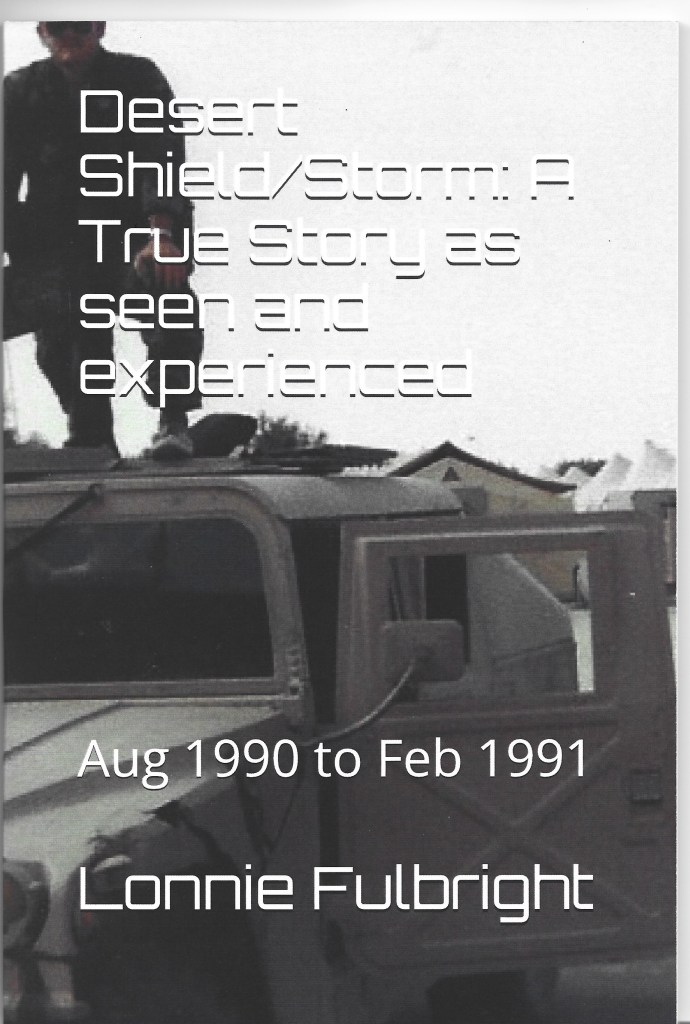
Friday, August 3, 1990:
I went to work and the entire squadron was buzzing. Everyone was running around getting things in order for this deployment. For me it was beginning to set in, “We were going to WAR.” The reality of it was kind of surreal. Some have been to war, Grenada when the U.S. went in and rescued the U.S. citizens, and Panama in operation “Just Cause”, but most of us have not, so the air of excitement flowed like electricity. Then all the teams were notified and instructed to get our Mo-bags ready. We went to supply for additional uniforms and some battle gear while our supply section continued to put together everything else we would need for deployment. Everyone is talking about what’s happening and the anticipation of it. We are all then placed on telephone stand by.
I went home after work and the news is still broadcasting the events as they unfold. My sweetie wasn’t at all happy about what was about to happen, of course what wife would be. War isn’t something a wife gets excited about. I could not tell her all the details because I didn’t have all of them and besides that, the thought of me going to war, with another possibility that neither of us wanted to contemplate, was a hard nut to swallow.
Saturday, August 4, 1990:
In the early morning hours it happened, Recall. We are told to show up at the squadron building in the guard mount room with full gear and bags, so, the hard chargers of the first SPS respond with eagerness and begin our wait for word about our departure. We are talking about the 1st SPS Air Soldiers. Oh yea, real deal killers.
The day moves on and we are gathered there waiting for our fearless leader Col. Allen Pack, to arrive to bring us up to date on the situation to include that “Some of YOU” won’t be coming back” speech. Notice I said the word YOU. That sort-of indicated that he planned his return but not ours. Makes you wonder.
It is funny to think back on though, because when he came in he was so loaded down with gear that each of us thought we had missed something. We are now are on telephone standby and to either, go home or back to duty. This is Saturday afternoon.
Sunday, Aug 5, 1990:
I made sure that my Supervisor had a phone number to reach me while we went to church. When we got there, everyone was talking about it and the spirit there was a little somber. The thought of some of the folks at the Church leaving to go into war was not one of enjoyment. The people prayed for our safety and return.
Monday, Aug 6, 1990
The Security Council imposed a worldwide ban on trade with Iraq.
Between 4 and 5 am this morning I got the word to report to base operations for mobility processing. I get up and tell Glenda, “this is it.” I quickly get dressed and she goes with me too the armory. She drops me off and I say good-by telling her not to worry. Others were there doing the same things with their families. I turned and waved one last time and went in to get my weapon. After we were armed, we loaded onto the bus and headed for base ops. Once there we received our initial set of orders for 32 days in support of combat operations. Not long after, we received our gamma gobulin shots. After we found out we were not scheduled to leave for a few hours, I called Glenda and had her go buy some batteries and a book for me. At about 10:00 she came with the kids and I was able to tell them I loved them and to take care of mom. Then, shortly afterward, 29 of us walked up the ramp of a C-141 and found a place to sit, in cargo seats. I am up front near the cockpit, (Very Uncomfortable). All of our equipment had earlier been loaded and secured and as we walked along the side headed for our seat, you could feel the excitement in the air and see it on our faces along with some anxiety. Inside a C-141 there is not type of noise reduction material so when the engines start, there are four of them, the noise from those engines is deafening. We were issued earplugs so every one of us immediately put them in. I looked around just to take it all in. Both sides of the aircraft was lined with cops, all talking, adjusting and preparing. The wait seemed long but it wasn’t, just 30 minutes. At that time, the pilots brought the engines up and the C-141 began to taxi down to the end of the runway. We could feel it as it turned onto the runway where the pilot brought the engines up to full throttle and rolled that big C-141 down that concrete. When it reached its take off speed, the nose lifted into the air and soon we were off the ground. We heard the landing gear raise and lock. The plane banked slightly to the right and the 1st SPS Air Soldiers were on their way to begin our first stages of preparing for war. I have read plenty of books about the soldiers in World War II and Vietnam, but this time it wasn’t those men, it was us, we were really going to war. This was our time to make history, to talk about those things done, as your grandchildren will ask about, the big war. We were excited and afraid, all at the same time, because we were on our way to meet a very dangerous and determined enemy and we had no idea what to expect.
Our first stop, according to the flight plan, was supposed to be in Spain. However, we developed a problem, a cracked windshield and had to set down at Charleston AFB, South Carolina. We got there, disembarked, and began a short wait. We watched the news, talked about what we were doing and speculated about the outcome. We knew the Air Force had sent in the best ones for this job, or so we told ourselves’ and that Saddam “Insane” just as well pack it up and go back home. After spending a couple of hours in the terminal, we were told the plane was fixed and we were back on our way.
On board our aircraft was the advanced HQ element with none other than “Wambo” and Capt. Lisa Christian as his second, they sat up front.
I heard afterwards, from those on the other plane, that the same thing happened on their plane as it did on ours and that was with the equipment pallets. They were stacked all along the center isle of the aircraft and if you were fortunate enough to be near one, you could get a comfortable place to sleep and rest and believe me; no one was giving up an inch on any pallet.
I am not sure of the date but after, being packed in like sardines for what seemed like forever, we were glad when we landed in Spain. It was great to get out of that plane and head for the terminal to rest a little, but that was short lived, a few hours later we were air born again and continued our journey to our forward deployed location, a place called Dhahran Saudi Arabia, the “Sand Box.”
While we were in the air from Spain, Col. Pack thought it a good idea, and it really was, to have some gas mask drills. He told us that we may be going into a chemical environment so we needed to be ready. When we were about 12 hours out, we were instructed to change our filters. We did. No telling what was going through the minds of each one. As for me, I really didn’t want to die in a place this far from home and especially because of chemicals. I have seen the horror pictures of what chemical agents can do to a body and I really didn’t like the idea of being subjected to that. So, I gladly made sure my gas mask was prepared and that I could get it on without delay.
NOTE: According to the time frame, documentaries, and of course the fact that we were there watching them get off the plane, The Army (101st AB) were the first combat units to respond. BUT THAT IS A BIG NO. The “First” responding combat units were, and will always be the 1st TFW/1st SPS.
Wed. Aug 8, 1990:
Our fighters, F-15 eagles made the trip, getting some midair refueling and upon arrival in Saudi Air space, set up shop and established the control of the air, allowing us to land safely at “Dhahran”. At about 0930 Saudi time, the pilot made the announcement of our approach and soon we touched down. We could feel the reverse thrust action as the plane began to slow down. Everyone got ready.
After we taxied to our spot in the middle of the ramp and the pilot went through the engine shut down procedures and then lowered the ramp. We were already standing as it opened up. The blast of the, 120 degree, heat rushes in and just about takes our breath away.
“Ho man that’s hot.” Someone said as we approached the ramp.
The sweat immediately poured out of our pores, but as quickly as it poured, it evaporates. We were told that here the heat is a dry heat and when you sweat, you don’t feel it, that you can dehydrate very quickly, so we needed to carry at least two quarts of water with us everywhere we went.
The advance element of 28 men and one woman grabbed our weapons and a-bag and made our way down the ramp and onto the tarmac. We formed into two columns.
We walked across the tarmac heading for the hanger that we would use as our initial HQ. Security, being the first order of business, was established, and after another hour, we were checked in and had our first war briefing. We were all very tired but the adrenaline that flowed kept us moving along. All of us knew that the first few weeks will be vital and each one of us wanted to get going and get it done.
The Col. addressed us, “Gentlemen, we are here to protect and defend the U.S. military assets assigned to and coming through this installation. Terrorist and special forces are our enemy. They will do whatever it takes to disrupt and destroy this base. There has been no declaration of War, as of yet, however, we will be ready for it. We will be at 100 percent. The other half of our contingency will be on the ground soon so, be on your toes. Our first order of business is to establish a perimeter around this structure and a 24-hour guard on all equipment, MSgt Bonefont has that task. Let’s get to it.”
I was part of the security element so I fell under his command.
We didn’t know it at the time, but Dhahran was in the process of a shutdown of all air operations. With the request for the U.S. military assistance for a “Desert Shield” and the war (Storm) that would follow, a complete reverse of that was implemented. The priority now, for airfield management, was making the parking ramps and hangers operational to start receiving the massive influx of inbound personnel and equipment that would begin arriving in the next couple of days.
 THE DEFENDER